New York Hakka Conference schedule

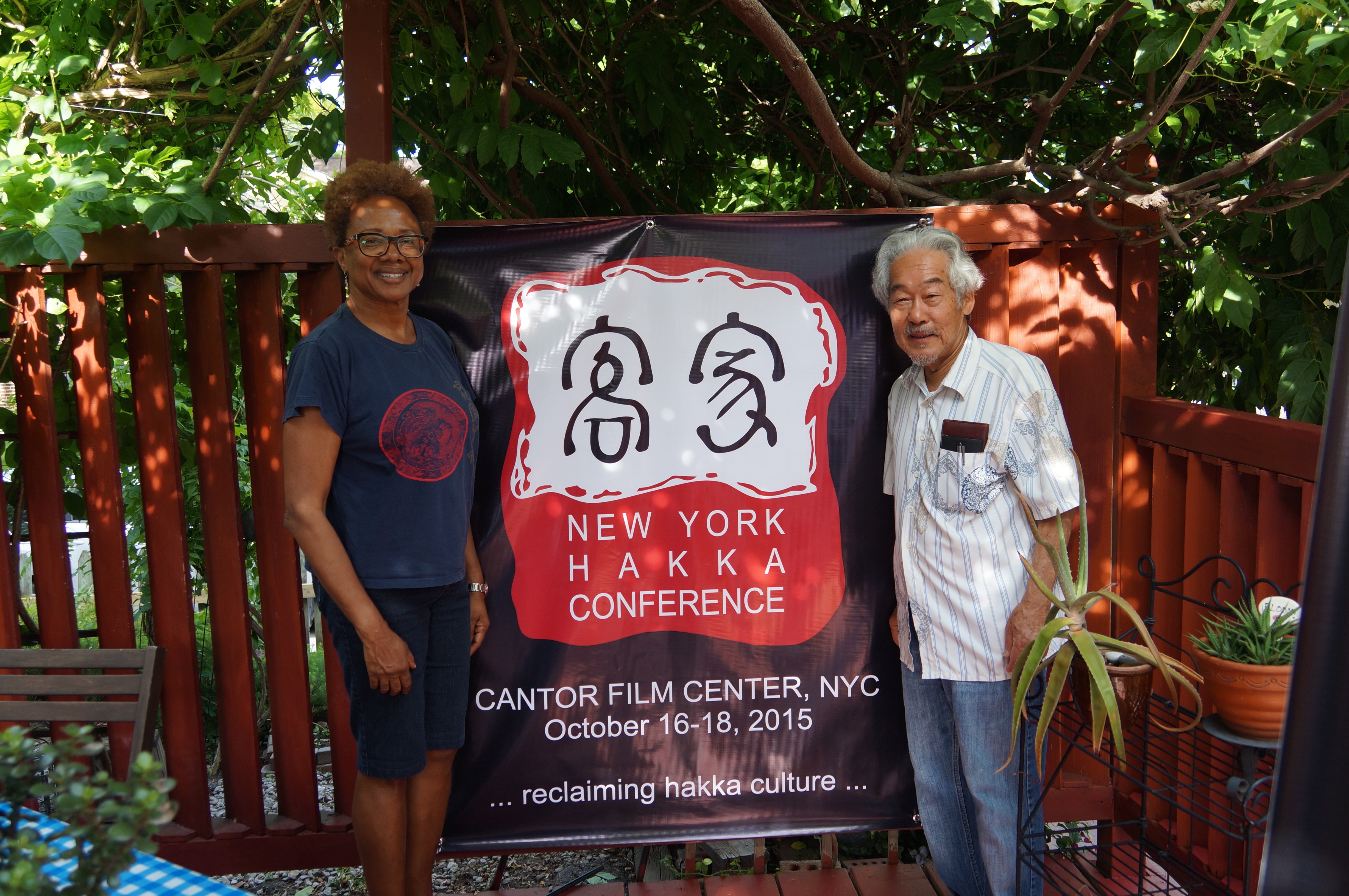
nyc Hakka I am putting together a slide show for The New York Hakka Conference. My subject is Hakka Cuisine so I plan to show photos of Hakka food and share stories I encountered on my global journey to research The Hakka Cookbook. Register for the conference and learn more about Hakka history, identity, and food. Following is a tentative schedule of events:

FRIDAY, OCTOBER 16, 2015

Museum of Chinese in America (MOCA) at 215 Centre Street, New York, NY 10013

RECEPTION at the Museum of Chinese in America (MOCA). 7:00 PM Feature presentation – The Nation Music of Jamaica’s Byron Lee. Starting a calypso and mento group in high school, Byron founded the Dragonaires as a big dance band that held sway over four decades in Jamaica and the Caribbean, as well as in  the diaspora cities of London, Miami, New York, and Toronto. From ska to rock-steady to reggae and soca, mambo and cha-cha-cha, Byron reproduced the international signature music of the Caribbean.


SATURDAY, OCTOBER 17, 2015 NYU Cantor Film Center at 36 East 8th Street, New York, NY 10003

9:00AM OPENING CEREMONY (Room 200)
9:15 – 10:30AM THE SEARCH for MY CHINESE FAMILY –  Paula Williams Madison screens her documentary and reads from her book, “Finding Samuel Lowe: From Harlem to China” (Room 200)
10:30 – 10:45AM BREAK
10:45 – 11:30AM CHINESE NAMES, HAKKA GENERATIONS – Dr. Keith Lowe, co-founder of the Toronto Hakka Conference, uses the Lowe family to illustrate the clan system that is the backbone of Chinese civilization. (Room 101)
10:45 – 11:30AM RESTORING THE CHINESE CEMETERY – Robert Hew and Robert Lee, leading members of the cemetery team of the Chinese Benevolent Society of Jamaica, describe the restoration of the cemetery that was unused for three decades.  Records have been translated and carried over to a database which reveals the location of one’s ancestors. (Room 102)
11:30AM – 12:30PM AFRO-CHINESE RELIGIOUS PRACTICES in CUBA – Dr. Martin Tsang, Florida International University (Room 101)
12:30 – 1:30PM LUNCH (Non-hosted) Please enjoy the wide selection of local restaurants.
1:30 – 2:45PM CHINESE SUCCESS AS SHOPKEEPERS, BAKERS, ENTREPRENEURS, Part 1 –  Alexandra Lee moderates a panel consisting of business leaders Vincent HoSang, Vincent J. Chang, Butch Hendrickson, and Dalton Yap. (Room 102)
1:30 – 2:45PM REVOLUTIONARIES AND CHANGE MAKERS – Prof. Richard Bohr, Dr. Samuel Lowe (Room 101)
2:45PM – 3:00PM BREAK
3:00 – 4:00PM CHINESE SUCCESS AS SHOPKEEPERS, BAKERS, ENTREPRENEURS, Part 2 – Alexandra Lee moderates a panel consisting of business leaders Vincent HoSang, Vincent J. Chang, Butch Hendrickson, and Dalton Yap. (Room 102)
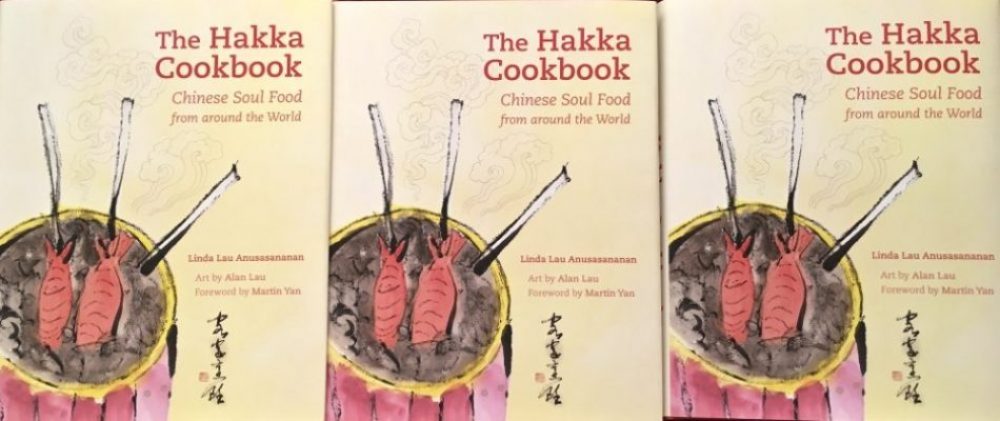
3:00 – 4:00PM HAKKA CUISINE – Linda Lau Anusasananan, author of The Hakka Cookbook: Chinese Soul Food from Around the World (Room 101)


SUNDAY, OCTOBER 18, 2015

NYU Cantor Film Center at 36 East 8th Street, New York, NY 10003

9:30 – 10:30AM HAKKA EARTH BUILDINGS AS WORLD HERITAGE – Ruifeng Liang, Professor of Engineering, Western Virginia University (Room 101)
9:30 – 10:30AM HAKKA MIGRATIONS – Patrick Lee, author of Chinese Canadian Jamaicans & Chinese Jamaicans Worldwide (Room 102)
10:30 – 10:45AM BREAK
10:45AM – 12:00PM MASTERING CARIBBEAN MUSIC and ART, Part 1 – Panel Discussion: Broadcaster Francine Chin, VP Records President Randy Chin, and author Kevin O’Brien Chang (Room 101)
10:45 – 12:00PM MIXED RACE PERSONS Screening of documentary, “Half,” produced and directed by Jeanette Kong (Room 102)
12:00 – 1:00PM LUNCH (Non-hosted) Please enjoy a the wide selection of local restaurants.
1:00 – 2:30PM MASTERING CARIBBEAN MUSIC and ART, Part 2 – Panel Discussion: Broadcaster Francine Chin, VP Records President Randy Chin, and author Kevin O’Brien Chang (Room 101)
1:00 – 2:30PM CARIBBEAN CHINESE LITERATURE and ART – Easton Lee reads poems and stories from his many books based on a lifetime spent developing Jamaican culture from the village square to the international stage. (Room 102)
2:30 – 2:45PM BREAK
3:00 – 4:15PM WRAP UP & CLOSING CEREMONY in Room 200


New York Hakka Conference

nyc Hakka“Reclaiming our Hakka Heritage” is the theme of the first New York Hakka Conference. This conference aims to educate people of Hakka and Hakka-Chinese descent in retaining and adapting their traditional culture. Any interested person can attend. The conference starts Friday night October 16 and ends Sunday October 18, 2015.

A festive Friday evening reception at the Museum of Chinese in America kicks off the conference with The Nation Music of Jamaica’s Bryon Lee.

On Saturday and Sunday film screenings, panel discussions, and presentations will be held at the Cantor Film Center at New York University. View the documentary film, “Finding Samuel Lowe: China, Jamaica, Harlem. Learn about Hakka earth buildings, Hakka Migrations, Chinese names and Hakka generations, Chinese success as shopkeepers and entrepreneurs, and much more.

I will be sharing a slide presentation on Hakka cuisine on Saturday afternoon. Register NY Hakka Conference now and join me for a weekend of discovery.

Chinese New Year foods

Chinese New Year symbols Wishing you a prosperous new year!  Khiung Hee Fat Choy!  Welcome to the Chinese year 4713 on the lunar calendar that begins on February 19, 2015.

This is the year of the goat, (also called ram or sheep). Chinese celebrate for about two weeks with family reunions, festive banquets, symbolic decorations, red envelopes filled with money, and good wishes. The new year signals a time for renewal and is also called The Spring Festival.

Many foods eaten during the celebration have symbolic meanings. They may resemble or their name sounds like something that is auspicious. For instance spring rolls look like gold bars, kumquats resemble gold coins, open clams represent new opportunities, green vegetables suggest growth in business, noodles symbolize long life.

In preparation for talks I am giving later this month, I posted a question in an international Hakka group on Facebook. I asked them “Do you serve any special Hakka dishes for Chinese New Year?”

Here are some of the answers I received. Some are regional specialties or Hakka classics. Some are fancy dishes; others beloved humble family favorites. Responses came from Hakka from all over the world so the spelling for the Chinese names may differ than what you know. Maybe you will see some of your favorites here. 
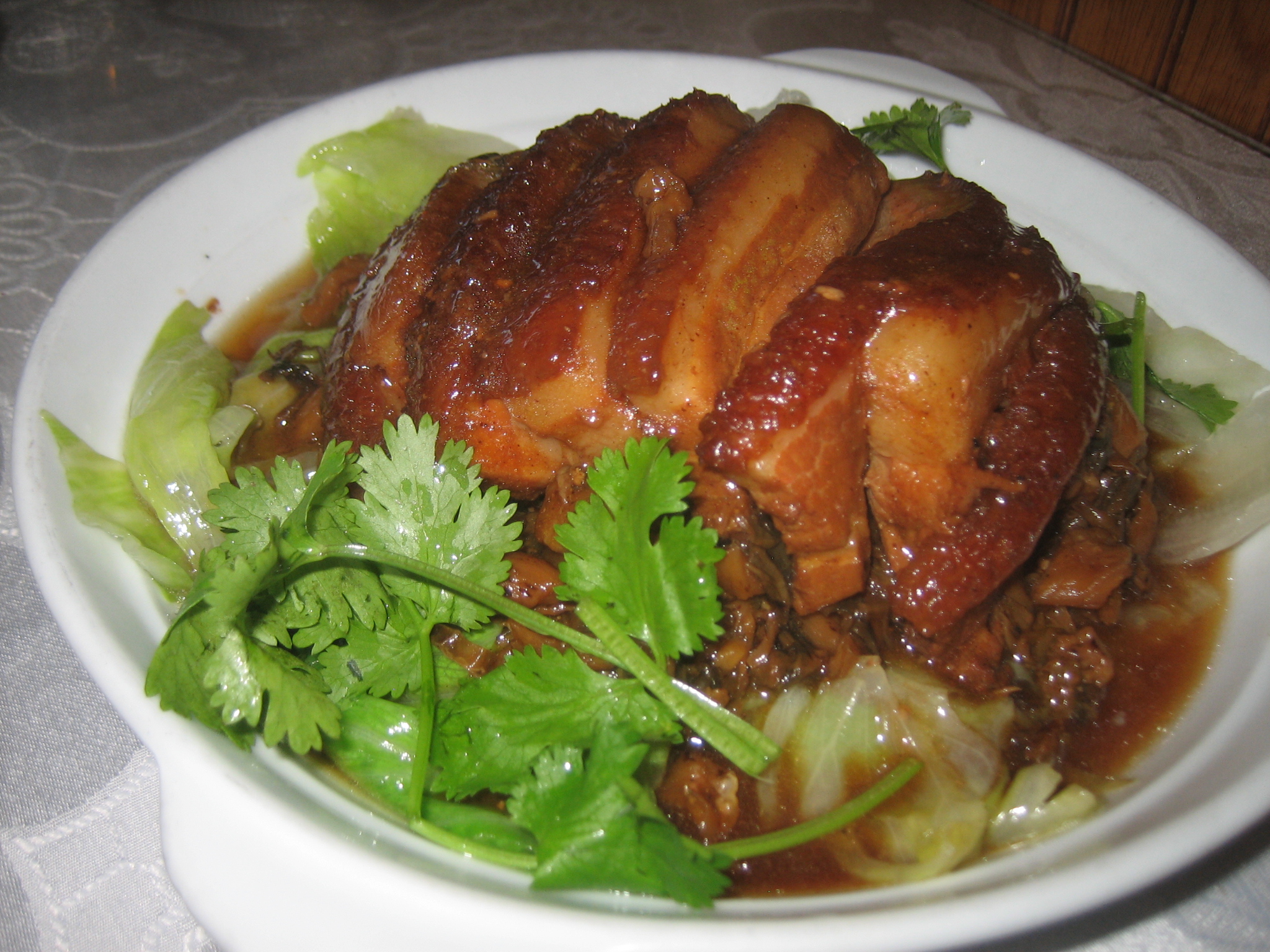
Pork Belly with Preserved Mustard Greens

Pork Belly with Preserved Mustard Greens

  • Pork belly with preserved mustard greens (kiu ngiuk moi choi)
  • Steamed minced pork with egg (choo nyuk jin gai choon)
  • ABC soup (lo song tong): soup with potato, carrot, onion, red dates, dry groundnuts, goji berries, meat or chicken carcass
  • Steamed fish with pickled mustard greens, red dates, tomato, and lily buds
  • Fried duck with plum sauce
  • Yellow wine chicken (wong jiu gai)
  • Pineapple chicken
  • Buddhist vegetarian stew (lo hon zai) Eaten on the first day of new year
  • Steamed chicken with salt (pak zm gai)
  • Fish maw soup (oem biao tong)
  • Sweet and sour duck (son moi ap)
  • Braised stuffed oysters with fat choy, and chestnuts (ngiong haw see)
  • Slice of pork liver wrapped in caul fat
  • Steamed fish with Chinese white radish in sweet and sour sauce (lo ped oem)
  • California squid with salted mustard green (ham choy)
  • Dried squid with celery
  • Stir-fried chicken with arrow root and vegetables
  • Surinamese Hakka-style chow mein made with spaghettini
  • Eight treasures duck (pat mui ap)
  • Black bean beef bone soup

What’s your favorite Chinese New Year dish? Here are some Hakka specialties featured in The Hakka Cookbook.  Have a delicious and Happy New Year! Khiung Hee Fat Choy!


Cooking class in San Mateo

Learn about Hakka history, my global journey to find my Hakka identity through food, and Chinese New Year traditions. Check out my new slide presentation for this special event at
San Mateo County Libraries located in San Carlos, Foster City, and Millbrae on February 25, 26 and March 4. The event is called Cooking Asian with Linda Anusasananan.

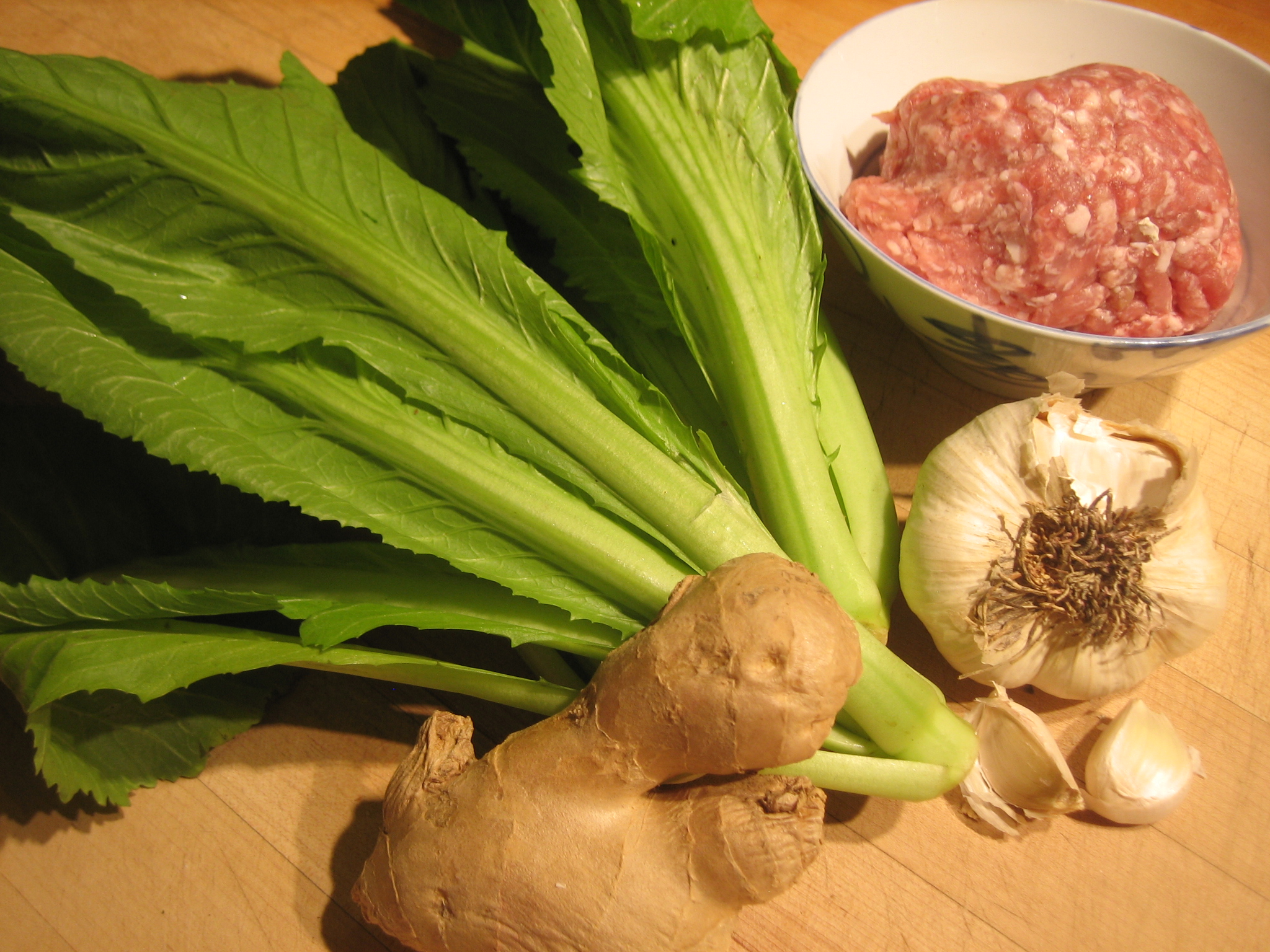
Ingredients Mustard green soupI will follow with a cooking class showing how to cook three easy dishes: Fresh Ginger-Onion Noodles, Mustard Green and Pork Soup, and a seasonal vegetable stir-fry. Recipes included. A tasting and book sale follows.

This event is free, but spaces are limited and you need to register in advance. Click on the highlighted links for details. Hope to see you!


Asia Society Hakka dinner


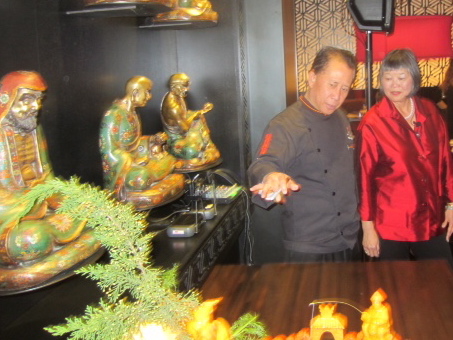
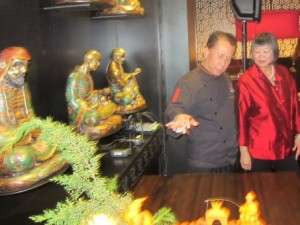
Martin Yan at Asia SocietyA few days ago, the Asia Society Northern California sponsored an event on Chinese Soul Food: Hakka Cuisine at M.Y. China in San Francisco featuring Chef Martin Yan, who wrote the forward for my book, and me. Robert Bullock, Assistant Director for Programs Northern California, proposed the idea almost two years ago. When we got a date from the globe-trotting celebrity Martin Yan, we were able to pull together an off-the-menu dinner program. So many people helped–Asia Society, M.Y. China, and A.F. & Co. They organized and publicized the event. Hanson Li of Saison Restaurant donated wine.
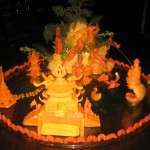
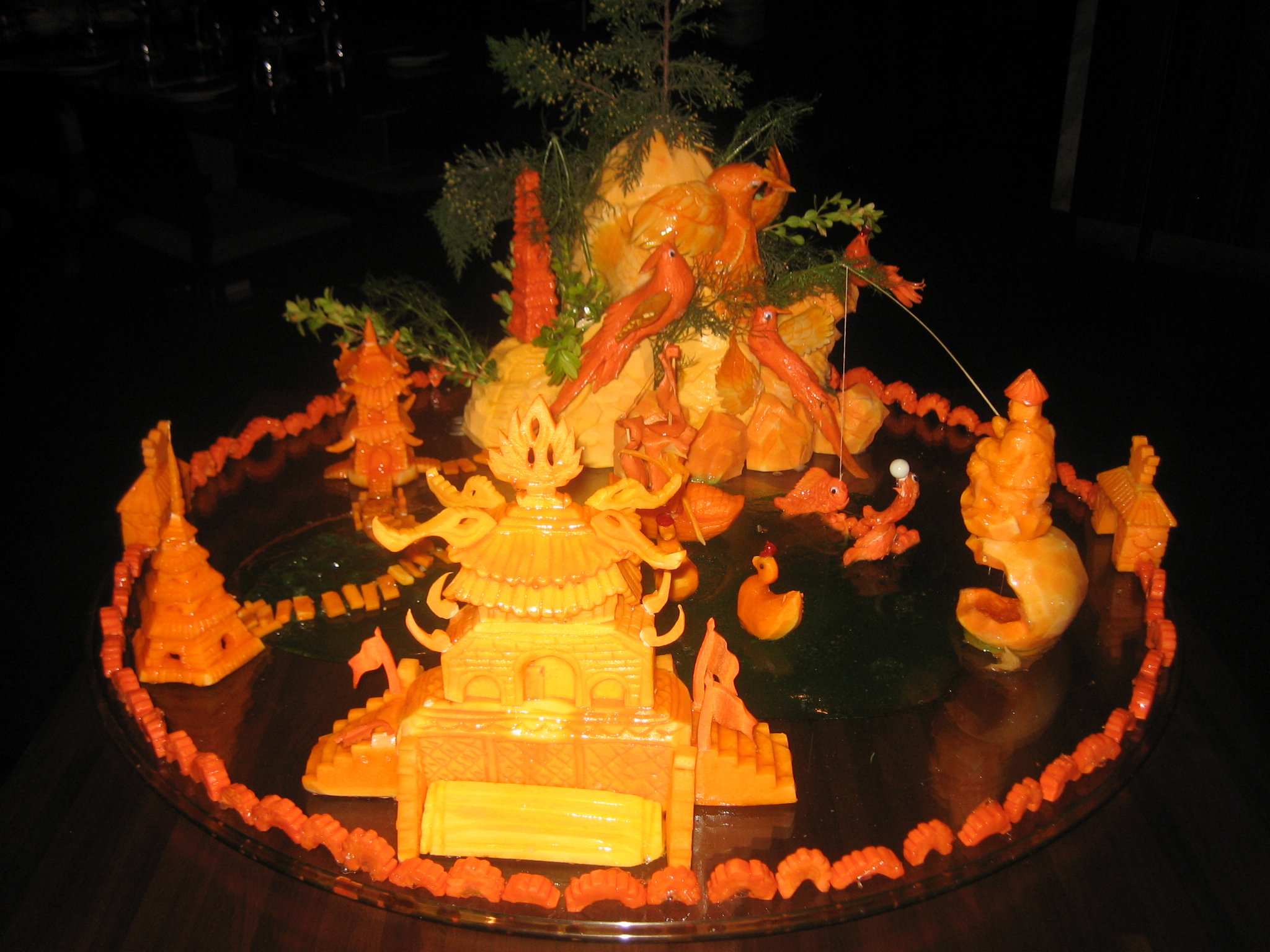
M.Y. China vegetable carvingMartin Yan and his chefs Tony Wu and Kin Fong and I collaborated on the menu. I was impressed that the chefs had studied my book and were able to convey an authentic Hakka flavor to the dinner. Even the intricate vegetable carving by Executive Chef Tony Wu reflected the mountain home of a Hakka village. With the exception of the bitter melon palate cleanser and the dessert, the menu reflected recipes from the book. Let me share the evening with you.
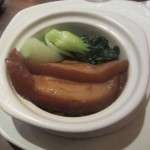
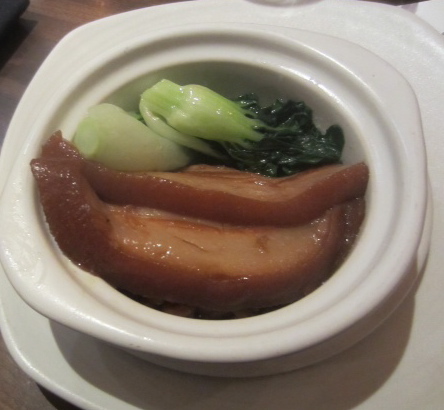
M.Y. China Pork BellyAfter Martin and I talked about Hakka history and cuisine, the meal opened with a Hakka classic, Pork Belly with Preserved Mustard Greens (kiu ngiuk moi choi). This dish epitomizes traditional Hakka characteristics: robust flavors, hearty satisfaction from the rich pork, and salty savoriness from soy sauce and preserved vegetables. M.Y. China’s rendition melted in my mouth. Individual portions were presented in small clay pots. To make this dish at home, see pages 42 to 44 in The Hakka Cookbook.
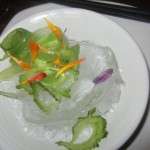
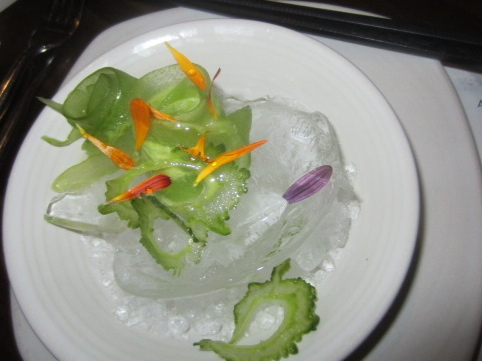
Bitter Melon M.Y. ChinaFor a innovative palate refresher, M.Y. China chefs created a new dish made from bitter melon, a popular vegetable in Hakka cuisine. I was a bit surprised when Executive Sous Chef Kin Fong suggested serving the bitter melon raw. Traditionally the bitter vegetable is cooked. It is often stuffed with a meat filling, then braised or poached. Slices may also be stir-fried. The chefs shaved raw bitter melon into paper-thin slices, blanched them briefly, and served them cold in an ice bowl. A scattering of edible flower petals and a dressing of acacia flower honey and wasabi elevated a humble vegetable to royalty status. The bitterness of the vegetable was toned down by blanching and balanced with the sweetness of the honey. Although Chilled Bitter Melon is not a traditional Hakka dish, it fit the meal beautifully, refreshing the palate and cutting the richness of the preceding pork belly.
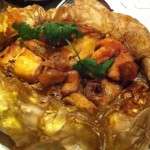
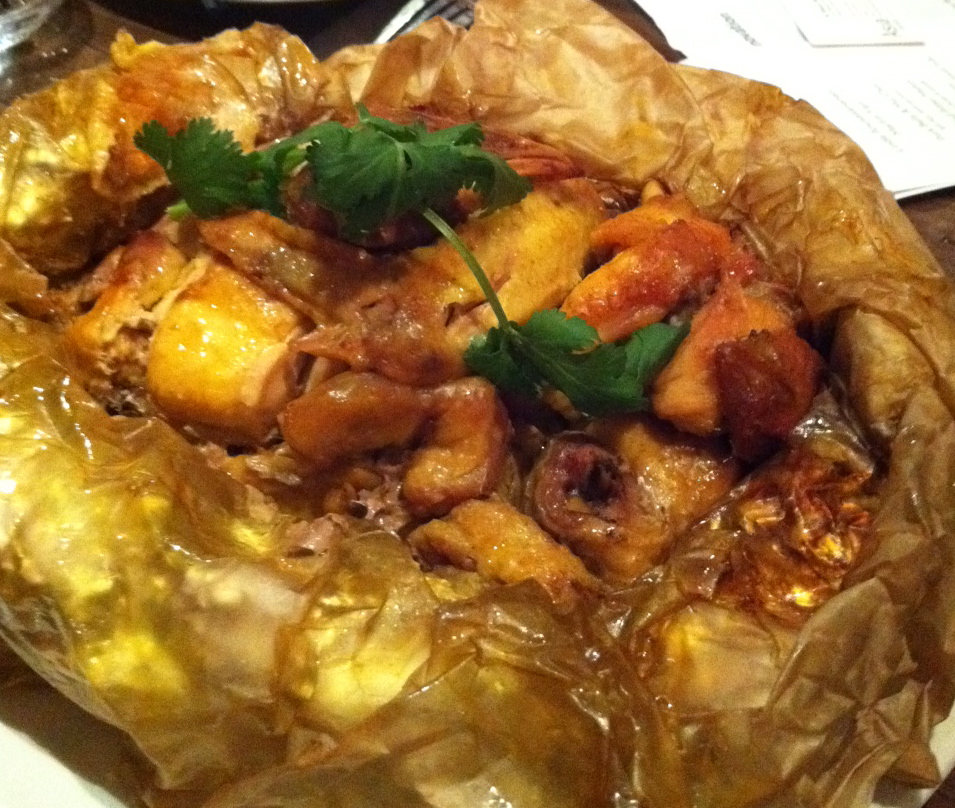
Salt-baked Chicken M.Y. ChinaOne of the most famous Hakka classics is Salt-baked Chicken. In China, the chicken is rubbed with seasonings, wrapped in paper, and cooked in a hot salt. The chicken emerges juicy and aromatic. Outside of China, most restaurants and home cooks do shortcut versions, either rubbing the chicken with salt and steaming or poaching the chicken in salted water. The results more closely resemble Cantonese white-cut chicken. M.Y. China took no shortcuts and cooked the classic version in salt, a rare treat. They showed the guests the whole chicken, partially wrapped in paper and nestled in the hot salt. Then they returned to the kitchen to cut the chicken and brought it out with a ginger and scallion sauce.  For a recipe for the home cook try my version on page 64.
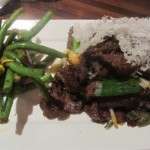
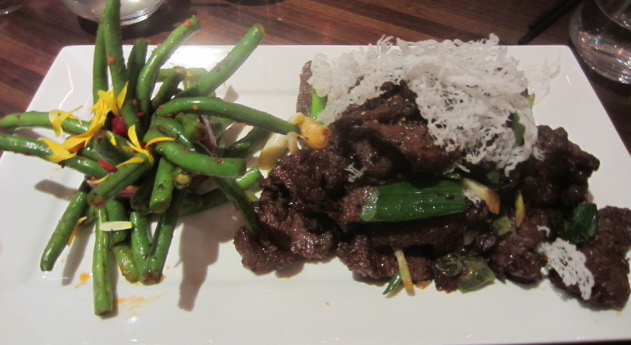
M.Y. China cumin beefCumin Beef is creation of Hakka chefs from India who created a new fusion cuisine to appeal to their Indian customers. It blends Chinese cooking techniques and ingredients with Indian spices. In this dish, beef is stir-fried with cumin seeds, chile, and soy sauce for a cross-cultural fusion of enticing flavors. M.Y. China used American Kobe beef in their version. This is an easy dish to make at home, see recipe in The Hakka Cookbook on page 183.
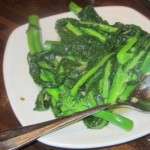
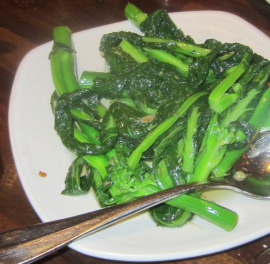
M.Y. China gai lonThe simplicity of the Chinese broccoli (gai lan) with Sweet Rice Wine (page 230) balanced some of the stronger flavors of the meal. The same basic recipe could be used with other vegetables.
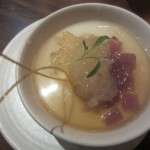


M.Y. China almond royaleM.Y. China ended the meal with Almond Royale with Ginger Syrup, a sophisticated variation of the Chinese pudding. A fresh zesty ginger syrup floated atop and seeped into an almond-scented panna cotta-like base.

The evening ended with noodle dances by the M.Y. China chefs. Imagine pulling noodles Gangnam-style.

Heartfelt thanks from a very grateful author to all who made this event so special and help me share the taste of Hakka soul food.


The Hakka Cookbook, a year in review

With book artist and brother, Alan Lau, at Book Larder in Seattle

With book artist and brother, Alan Lau, at Book Larder in Seattle


Just one year ago on September 29, 2012, I officially launched The Hakka Cookbook, Chinese Soul Food from around the World at the Asian Art Museum in San Francisco. It was a bit like giving birth in public after a seemingly endless pregnancy, more than seven years. The long labor was worth it.

What a great year! The press has been good to the book, gaining attention even at some of the big names such as New York Times, Wall Street Journal, Associated Press, and Martha Stewart Living.

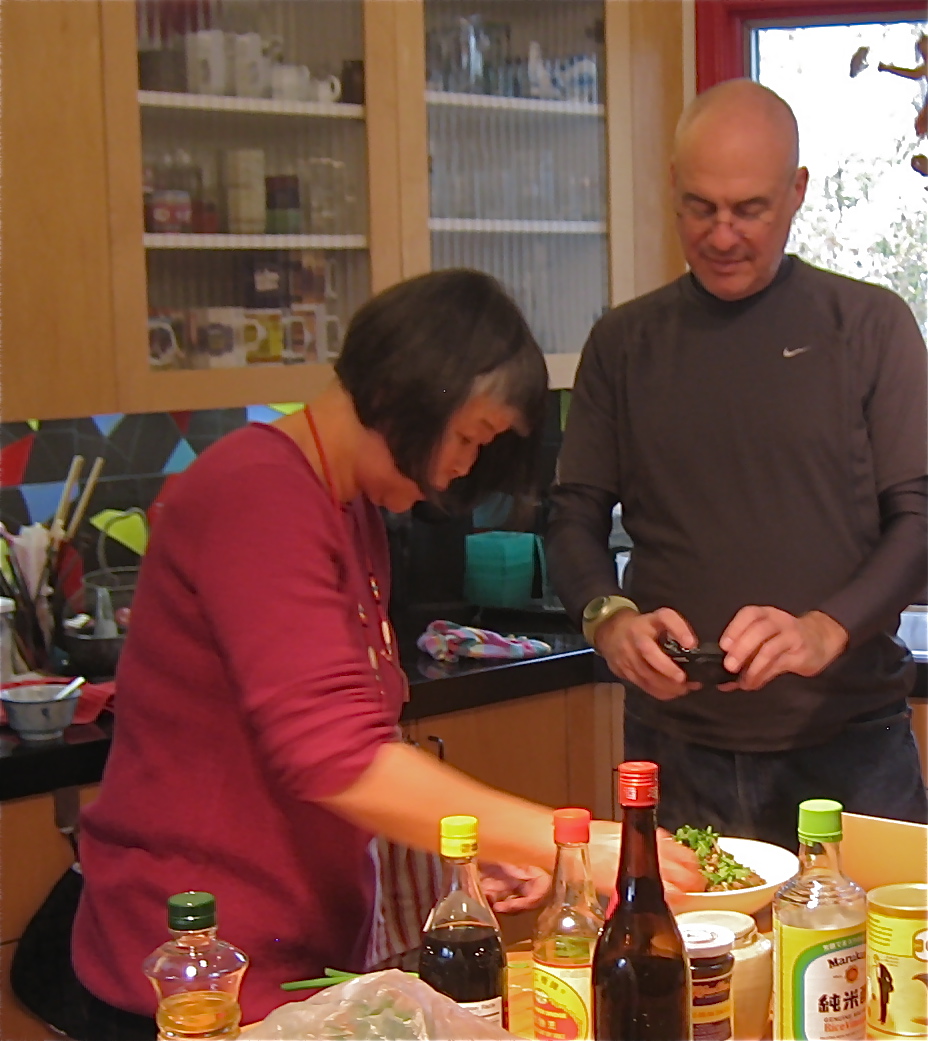
Cooking with Mark Bittman, NY Times writer.

Cooking with Mark Bittman, NY Times writer.

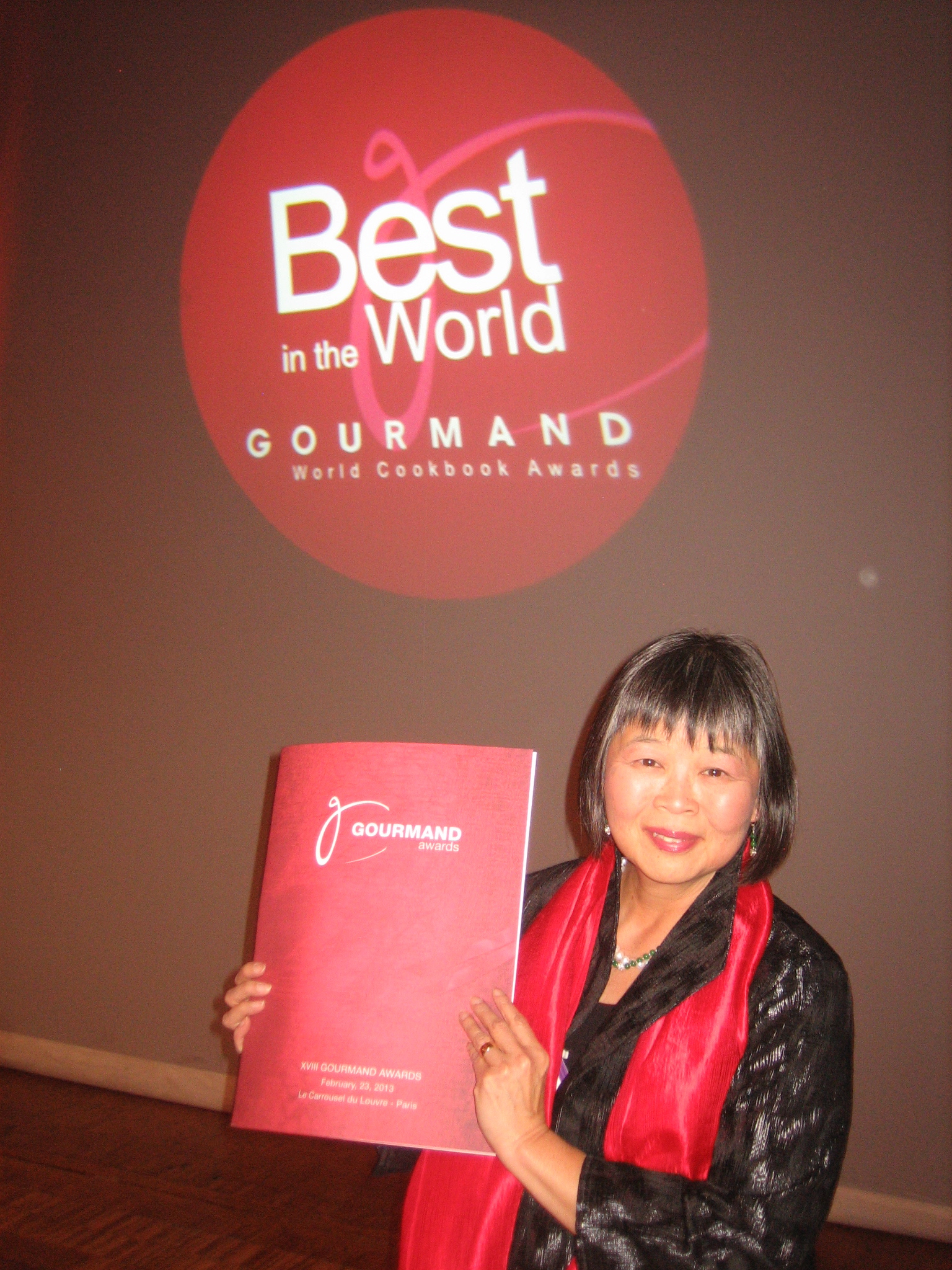
The Hakka Cookbook was recognized as “Best Chinese Cuisine Cookbook in the World” in Paris, I’ve talked about the book on the radio and cable television and many book signing events. Bloggers wrote very thoughtful and appreciate reviews. Best of all, I have connected and met with Hakkas from all over the world. Just shy of its first birthday, the book is in its second printing.

Here’s a quick summary of year one for The Hakka Cookbook. For details on this list, visit this page.

"Best Chinese Cuisine Cookbook of the World"

“Best Chinese Cuisine Cookbook of the World”

  • 21 Printed articles and reviews
  • 24 Digital and blog articles
  • 5 Best or Favorite Cookbook Lists
  • 3 Radio interviews
  • 1 Television/youtube interview
  • 1 Cookbook Award
  • 26 Book signing events

Thanks for all your support. Hope to meet you at a  future event.


Tea with Hakka Food

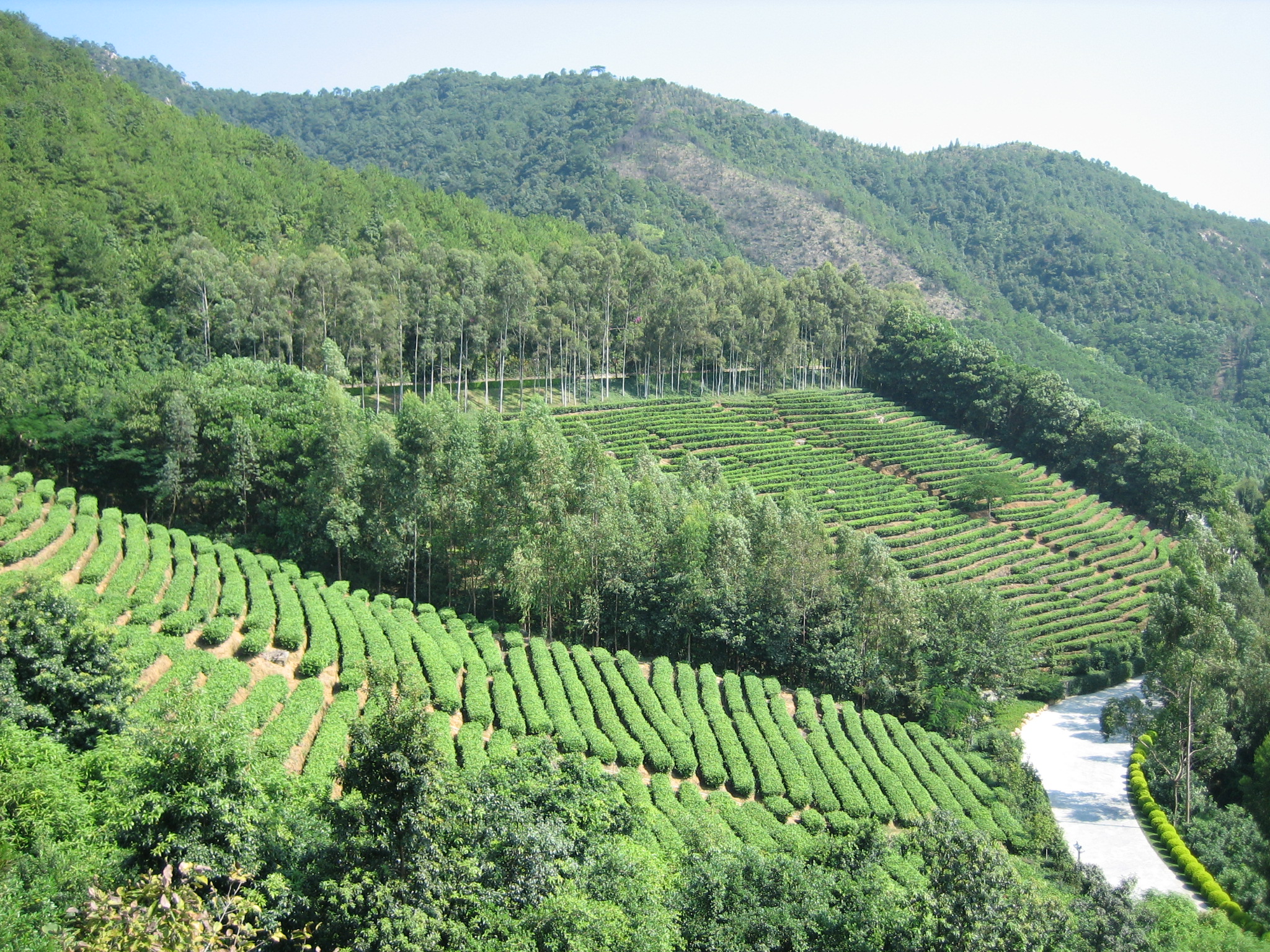
Yearning Tea Plantation in Meizhou China

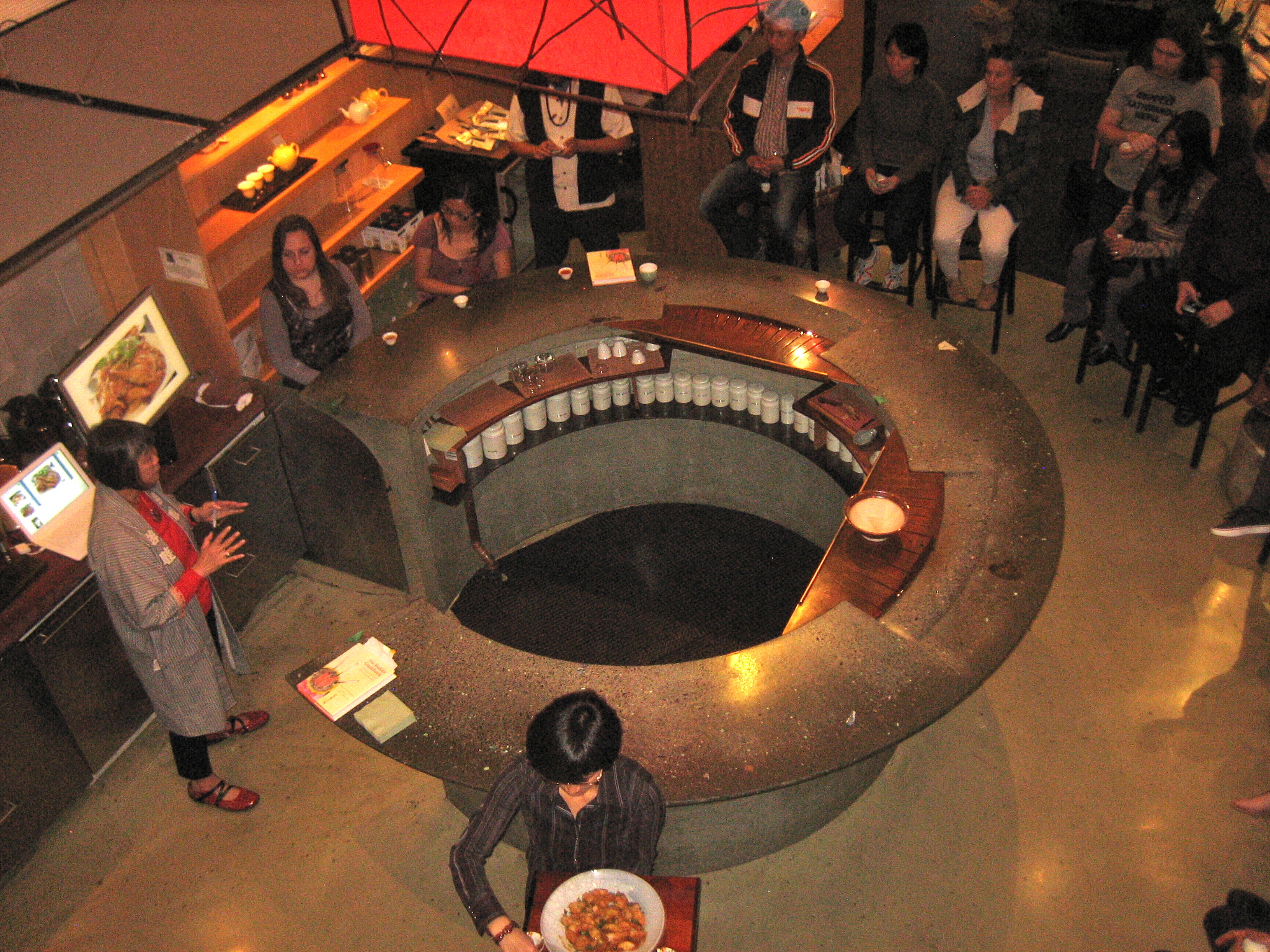
A few weeks ago, Winnie Yu, one of the owners of Teance Fine Teas in Berkeley, California hosted a book signing event for The Hakka Cookbook. In the zen-like atmosphere of this tea shop designed by Fu-Teng Cheng, the tea shop staff served several recipes from my book with premium teas while  I talked about my Hakka journey. The enthusiastic audience was relaxed and totally engaged. Perhaps that is the magic of drinking premium teas with food, it soothes the soul and creates energy.

Speaking at the tea bar at Teance Fine Teas in Berkeley, California.

Winnie says, “Appreciating artisanal teas is a lot like appreciating great wines.” For our event, she served mostly fine oolong teas, semi-oxidized and roasted teas that seem to go with a wide variety of foods. I think of oolong, similar to a Pinot Noir, with lovely aromas, complex flavors, and a full-bodied palate. The oolong teas can range from greenish and floral to darker and fruitier. We started with Old Grove Shuixian with dark cinnamon notes that we drank by itself while we waited for guests to assemble.

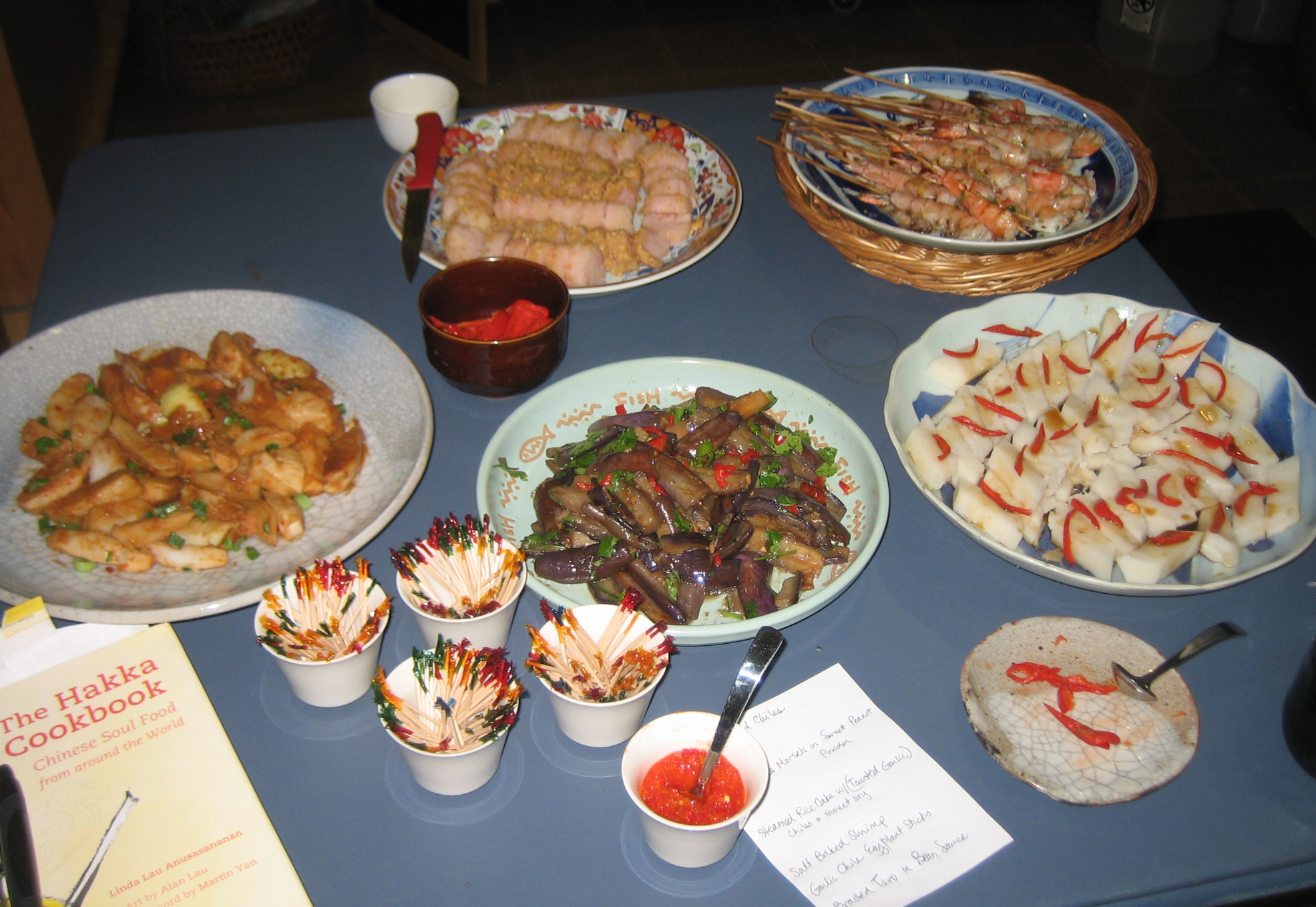
Behind the scenes, samples from The Hakka Cookbook to serve with tea at Teance.

We sipped the full-bodied Tieguanyin Light Roast with Salt-baked Shrimp (page 62) and  Garlic Chile Eggplant Sticks (page 56). Phoenix Almond Oolong with the taste of almonds complemented the neutral Steamed Rice Cake (page 174) with the sweet-sour-medium hot Pickled Red Chiles (page 72). We tasted the spicy-sweet Taiwan Beauty with the Chewy Rice Morsels in Sweet Peanut Powder (page 97).  With the robust flavored Braised Taro in Bean Sauce (page 219), we drank a Red Plum Black tea, a darker, fully oxidized tea.

This book event reminded me of our afternoon at a tea plantation on our scouting trip in China. In the mountains of Meizhou, we visited the Hakka owned Yearning Tea Plantation. There we tasted the local dancong tea, an oolong tea noted for its ability to soothe the throat. The company logo, a flying wild goose, represents the Hakka fleeing from the north to the south, a fitting tribute to tea and the Hakka.

A Hakka feast

Minced Pork with Lettuce Wraps

I discovered the Hakka Restaurant when I was almost done with the research for my book. Luckily I was able to include talented Chef Jin Hua Li and a couple of his recipes in my book. When the San Francisco Professional Food Society (SFPFS) asked me to put together a menu from the Hakka Restaurant for their Traveling Table, a program that explores the bay area’s unique restaurants, I was happy to share his delicious food with them. Here’s the menu.

Minced Pork with Lettuce Wraps
Bamboo Pith Seafood Soup
Chinese Bacon with Preserved Greens
House Special Pan-Fried Tofu
Fried Pumpkin Strips coated with Salted Egg Yolk
Chicken Stuffed with Preserved Greens (recipe pg. 233)
Stir-fried Chinese Broccoli with Rice Wine (recipe pg. 230)
Clams with Spicy Salt and Black Beans
Home-Style Steamed Sea Bass
House Special Eggplant
Steamed Rice

The lettuce wraps uses a well-seasoned pork as a simple filling for crunchy lettuce leaves. The mild soup, focuses on natural flavors and offers a light contrast to the more robust flavors in the meal.  The House Special Pan-Fried Tofu and the Chinese Bacon with Preserved Greens are Hakka classics. The Chicken Stuffed with Preserved Greens is one of Chef Li’s specialties, order a day in advance. The chicken is filled with a savory mix of preserved mustard greens, mushrooms, and pork, then braised.

Chicken stuffed with Preserved Mustard Greens at the Hakka Restaurant

The steamed fish is topped with a shower of typical Hakka ingredients pickled mustard greens and shreds of pork. Both the clams and eggplant dish reflect adaptations to local tastes as the Hakka migrated. The clams exude a spiciness reminiscent of Sichuan province.  The clams are deep-fried in their shells then stir-fried with fermented black beans, ground pork, chiles, garlic, and sometimes Sichuan peppercorns.  The tender eggplant tastes mildly sweet, sour, hot and aromatic with basil and cilantro, hinting of Thai seasonings. Hakka settled in both these areas, China’s Sichuan province and Thailand.

Everyone loved the meal. I think you will, too. The Hakka Restaurant is located at 4401-A Cabrillo Street (corner of 45th Avenue), San Francisco, CA 94121. Tel. 415. 876. 6898.

The Hakka Cookbook tours the Northwest

I’ve been traveling through the Northwest, sharing the story of The Hakka Cookbook. I’ve met many new people including a Hakka pharmacist  in Vancouver BC, originally from South Africa to a young woman in Seattle originally from Taiwan.

I’ve learned some tricks to a successful book signings. Invite all your friends and ask them to bring their friends to ensure you have a decent-sized audience. List your event in as many newspaper and blog calendars as possible. Here’s a short summary of The Hakka Cookbook events.

Portland, Oregon

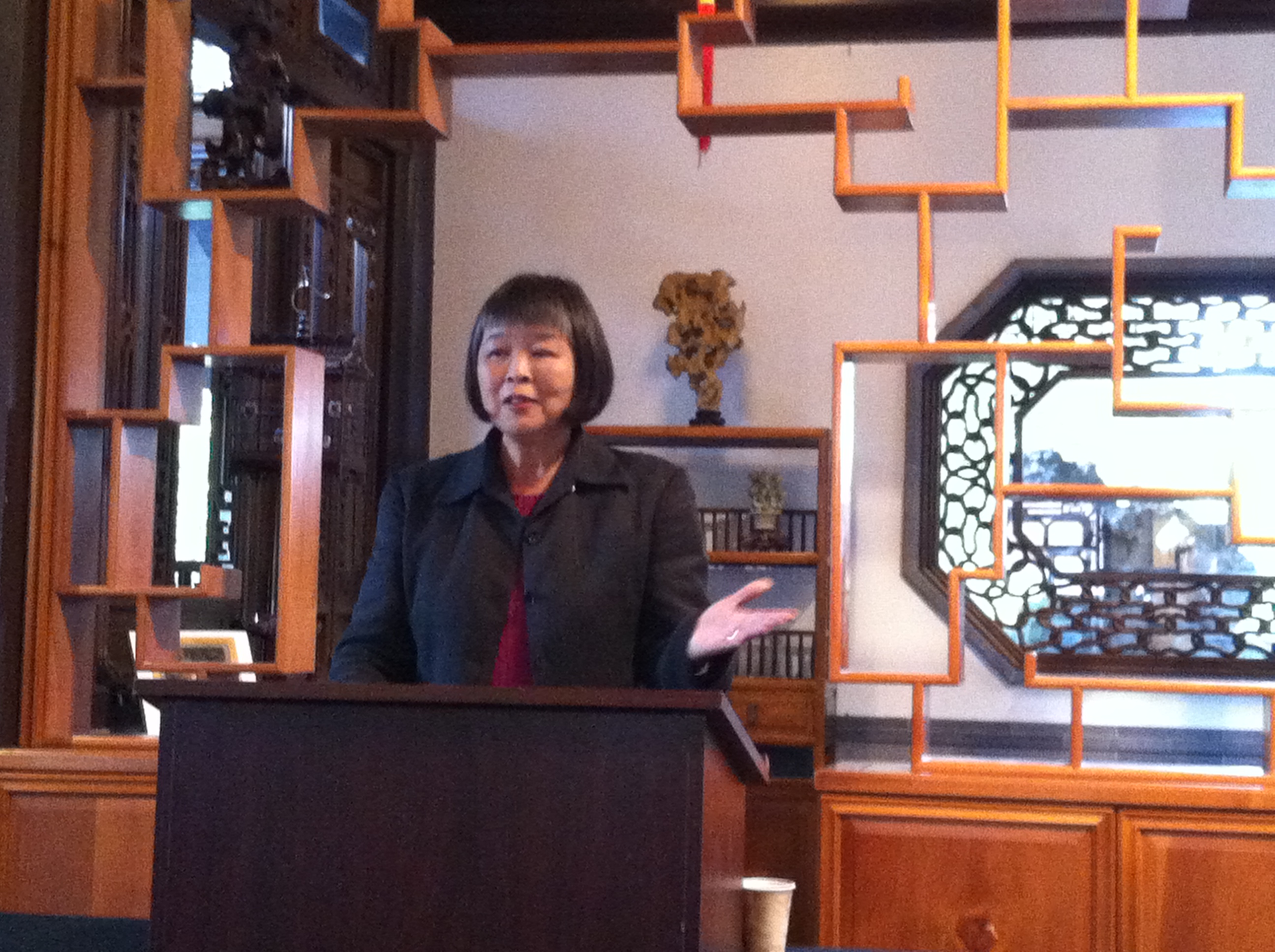
Speaking in the Scholar’s Study at Lan Su Garden. Photo by Emily Park.

I was honored to present The Hakka Cookbook to a group in the elegant, classically designed Scholar’s Study at Portland’s Lan Su Chinese Garden. A opulent display of pink mums decorated the room. The garden, considered the most authentic Chinese garden outside of China, was assembled by craftsman from China. It’s a beautiful gem located in Portland’s Chinatown. In the audience, I met some old friends.

Seattle, Washington

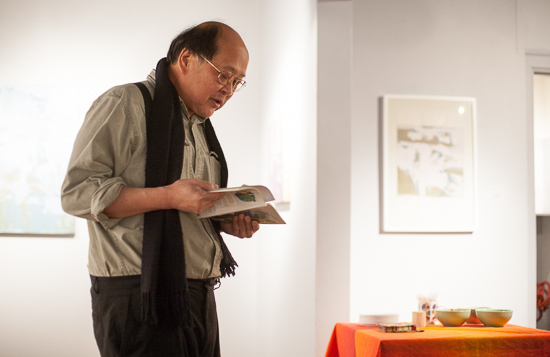
Alan Lau, my brother and artist for the book, joined me in all my Seattle events. In a bright room, lined with cookbooks, a crowd of about twenty-five gathered at the Book Larder.  Alan, also a poet, began with a dramatic reading of poems. Rachel Coyle, event coordinator, served chunks of Soy-Braised Chicken and Mushrooms (p. 204).

Alan Lau reads poems from Blues and Greens, a Produce Worker’s Journal. Photo by Barry Wong

Francine Seders Gallery, which represents my brother’s art, hosted a book signing and show of Alan’s paintings from our trip to China. Francine cooked Soy-glazed Chicken Morsels (p.199), Pickled Mustard Greens and Cucumbers (p.147) and Pickled Carrots and Radishes (page 60) for guests to sample.

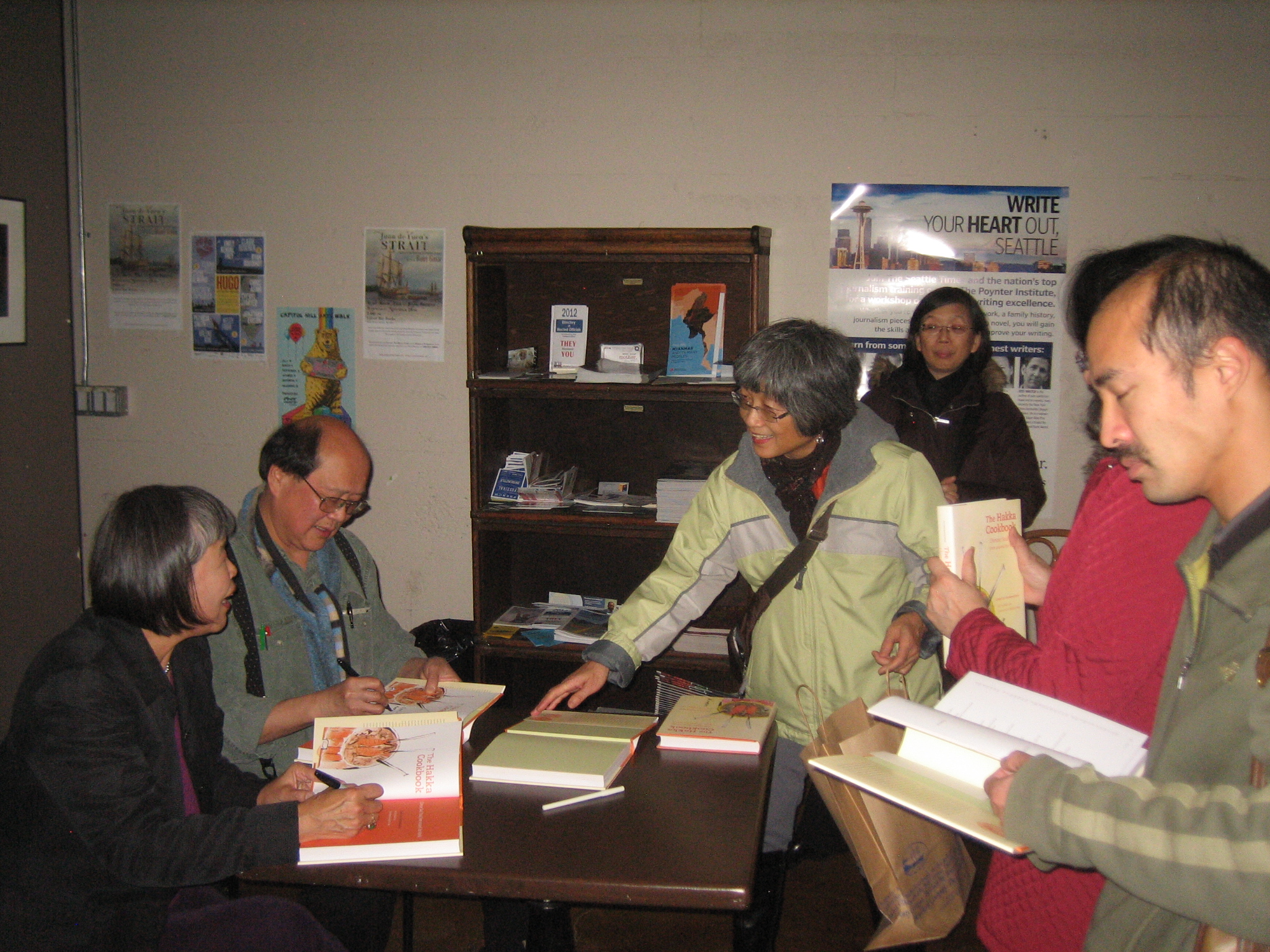
Elliott Bay Book Company, in the Capitol Hill area, is a large spacious store with a varied selection of books. Definitely, it’s a book lovers retreat.  Here we were pleasantly surprised by seeing a staff recommendation posted for The Hakka Cookbook.  We sold twenty books that night.

Signing books at Elliott Bay Book Company. Photo by Therdphong Anusasananan

Wing Luke Museum in the International district showcases the history of Asians in the area.

I recommend the guided tour. A young informative guide took us to an original store stocked with foods and ingredients that reminded me of my youth. I saw pouches of bitter black tea, that Popo brewed with water, ginger, and green onions when we came down with a cold. Shelves were lined with big glass jars filled with dried or preserved snacks such dried salted plums and candied ginger. We also toured the meeting room of a Chinese association. Later, we gave our book presentation with slides in the small theater. In spite of the rain, friends came to our presentation and bought more books.

Vancouver, BC, Canada

Barbara-Jo’s Books to Cooks hosted me in her warm cozy store. All seats were filled around the kitchen counter as we discussed the book and snacked on Soy-Glazed Chicken Morsels (p. 199) cooked by Mark.


The Hakka Cookbook at The Wok Shop

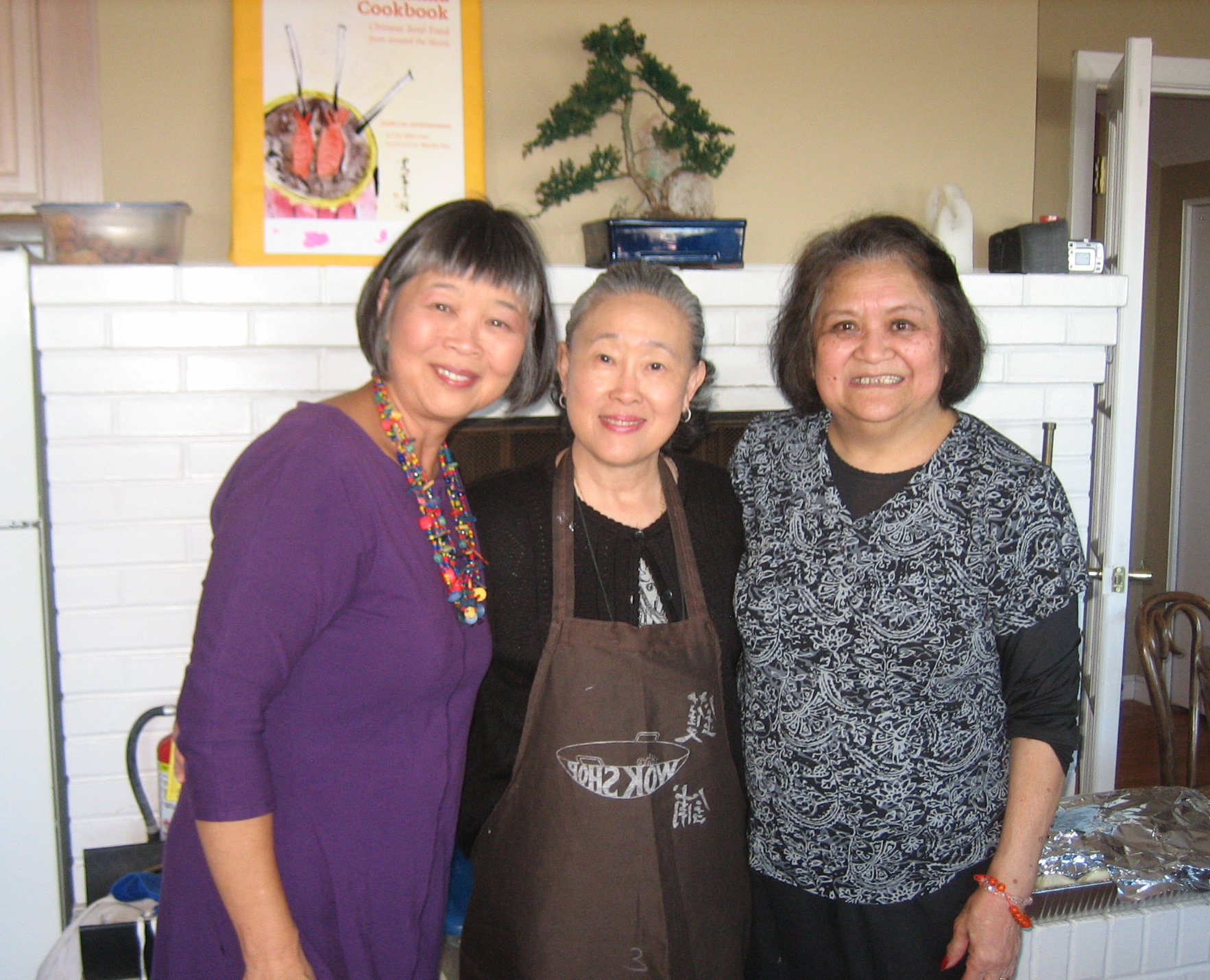
Linda, Fah, and Tane, owner of The Wok Shop

The Association of Chinese Cooking Teachers (ACCT) sponsored a party for The Hakka Cookbook at Tane Chan’s, owner of The Wok Shop in San Francisco. Tane was one of the original charter members of this group who started in 1983. I, too, have been president of this group. ACCT originally started to share their expertise about Chinese cooking.  Now, its culinary interest has expanded to include other cuisines across Asia. The group promotes the interest in Asian cuisines through eating, visiting markets, manufacturers, and kitchens.

The Wok Shop is the best place to shop for cooking equipment for Asian cooking. So Tane, who has been in business for more than 40 years, has a legion of loyal customers and good friends. They came to see her, eat, meet me, and buy the book. She provided her lovely home, dim sum, and noodles with JADE Sichuan Peanut Sauce. She also invited a Chinese fortune teller and a dim sum master to demonstrate.  I brought Hakka Pork Sliders. My friend Fah Liong, helped demonstrate a few simple vegetable dishes from the cookbook. We cooked Stir-fried Chinese Lettuce, Garlic, and Black Beans (p. 57), Stir-fried Spinach and Peanuts (p. 56), and Stir-fried Snow Peas and Tofu (p. 48).

Selling and signing books has never been more fun. Thanks Tane!