Savory Pounded Tea in Malaysia

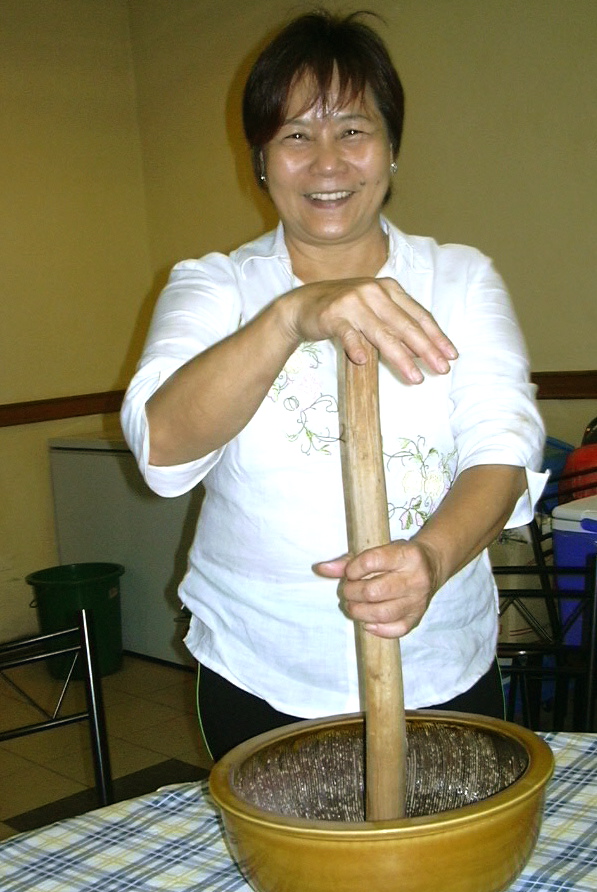
Amy Wong shows the bowl and stick she uses to make pounded tea.

Amy Wong shows the bowl and stick she uses to make pounded tea.

In my last post, I wrote about the sweet Taiwan version of a Hakka specialty, lui cha or pounded tea. It wasn’t my first encounter with this unique tea. I first tasted a savory version in a small café in Singapore where it was called thunder tea or pounded tea. Signs boasted the tea would cure all aliments–lower my cholesterol, ease digestion, boost my immune system, provide antioxidants and fiber, combat flu, and reinvigorate me. The dish consisted of a larger bowl of rice topped with little mounds of stir-fried greens, tofu, preserved radish, peanuts, and pressed tofu. A smaller bowl of a thick bright green tea, which resembled a thin pea soup came alongside. I was instructed to pour the secret green tea over the rice and mix it all together. It was delicious and energizing.Lui cha and garlic rice

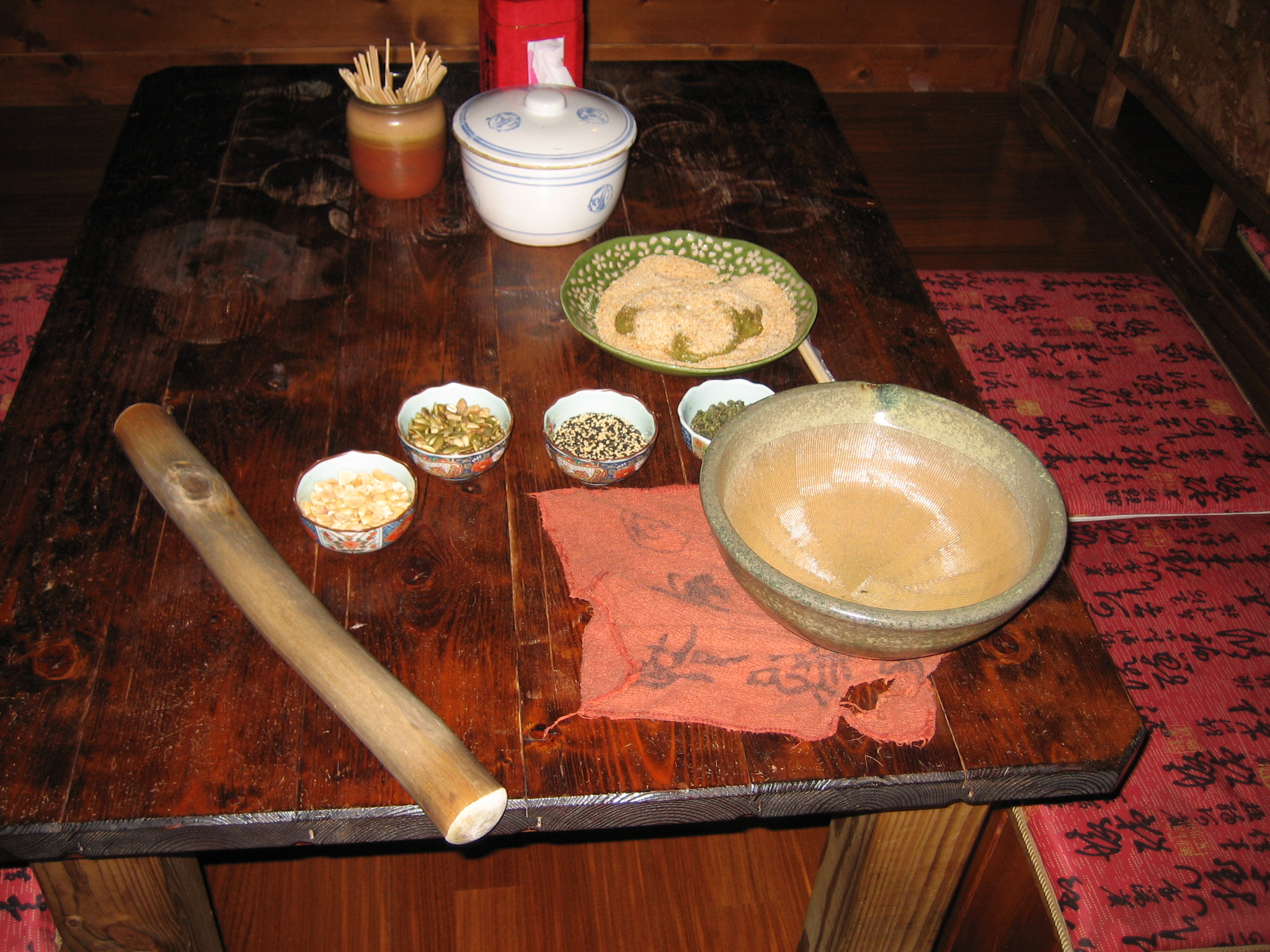
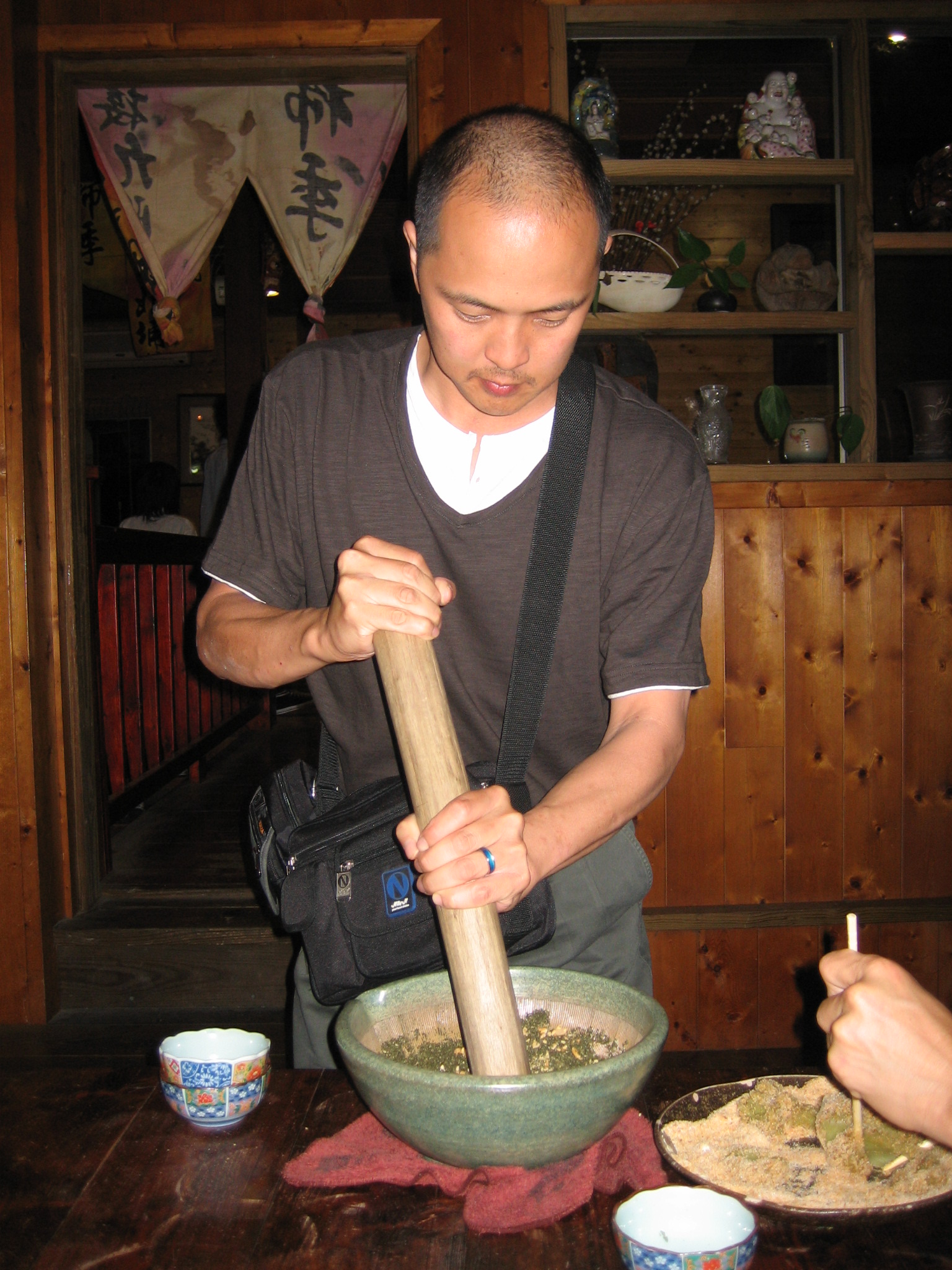
A few days later in Kuala Lumpur, I met Amy Wong at her Eiffel Restaurant and Dessert House (now closed). I asked her about the tea. She generously shared her recipe which was published in Famous Cuisine Home Recipes. She pounds a mixture of fresh green herbs such as basil, mint, and cilantro with dried green tea leaves, sesame seeds, and peanuts in a large rough textured bowl with a big stick, then adds boiling water to make a healthful herbaceous tea. She presents the tea with a bowl of garlic rice topped with vegetables, tofu, and nuts. When mixed together, the many elements merge to make a healthy rice bowl that explodes with vitality, flavor, and texture.

Each of many varied ingredients contribute a health benefit, texture, and taste which makes the end result so fabulous. My family loved this dish when I tested it. However with its long ingredient list, it is not quick to make. You can prepare many of the ingredients ahead. And if you can’t find some of the vegetables, adapt to what you have in your local market. In my recipe, I use an electric blender to simplify the preparation.

Here I offer only the tea portion of the recipe so you can compare it with the Taiwan version in the previous post. For a simple tasting, pour it over rice topped with some stir-fried greens, and pressed tofu. To find the complete recipe with the toppings and the garlic rice, see The Hakka Cookbook, page 120.

Herbaceous Pounded Tea from Malaysia

Makes about 5 1/2 cups, 6 to 8 servings

2 cups fresh Thai or Italian basil leaves

2 cups fresh mint leaves

2 teaspoons vegetable oil

1 teaspoon chopped garlic

1/4 cup chopped cilantro

2 tablespoons dried green tea leaves

6 black peppercorns

2/3 cup roasted salted peanuts

3 tablespoons toasted sesame seeds

1 cup cold water

4 cups boiling water

1 teaspoon kosher salt, or to taste.

1. Coarsely chop basil and mint. Set a 10- to 12-inch frying pan over medium-high heat . When the pan is hot, add the oil and rotate the pan to spread. Add the garlic and stir until soft, about 30 seconds. Add the basil, mint and cilantro; stir-fry just until the herbs turn bright green, about 30 seconds. Remove herbs from the pan.

2. In a blender, finely grind the tea leaves and peppercorns. Add the peanuts and sesame seeds; blend until finely ground. Add the basil mixture and cold water, and blend until smooth.

3. Just before serving, add 1 cup of the boiling water to herb mixture in blender and whirl until smooth, holding blender lid down with a towel. Pour tea into a 2-quart pan. Add the remaining 3 cups boiling water and salt; whisk until blended. Stir over medium heat until hot. Serve hot.

Hakka pounded tea in Taiwan

Ladle tea into bowls, add sweet condiments and puffed rice to taste.

Ladle tea into bowls, add sweet condiments and puffed rice to taste.

Have you ever tasted lui cha (Hakka) or  lei cha (Mandarin), also called pounded tea or thunder tea?  Recently there was a post on a Facebook group site about this Hakka specialty. Someone had  bought an instant mix for Hakka pestle cereal in an Asian supermarket and wondered what it was. I, too, have seen these packets and tried them, wondering if they were similar to the Hakka pounded tea I tasted in Taiwan. The instant version has a similar color and texture but the flavor seems a bit bland. In my recipe for a homemade version, you can taste the tea, smoothed by the richness of the nuts and seeds.

This beverage is is not like regular tea. In Taiwan, lui cha is made by pounding tea leaves, nuts, and seeds in a mortar and pestle, then blending with boiling water to make a  thick, creamy beverage.

To make lui cha, pound tea leaves, nuts, and seeds in a bowl with a stick.

To make lui cha, pound tea leaves, nuts, and seeds.

There are a couple of stories about the origin of this tea. Almost two thousand years ago, as a general prepared to capture Chengdu, his troops were felled by a plague. A Hakka doctor prescribed this unique tea. The soldiers were miraculously cured. Another story claims centuries ago on the mainland, when the Hakka migrated south to Fujian, Jiangxi, and Guangdong provinces, they couldn’t carry much. But tea was light, quenched their thirst, and when they added ingredients from the local area, it filled their stomachs. So the tea gained a reputation for being healthy and filling.

In 1989 in Taiwan, the Beipu Agricultural Department was looking for a regional specialty to attract tourists and keep their Hakka village alive. They interviewed a Hakka woman who told them how to make lui cha. They asked if the tea could be sweetened. She replied that it probably would not hurt. So the sweet Taiwan version was born. Another version is savory, more about that in another post.

In my research for The Hakka Cookbook, I visited a Hakka tea house Kwang Fu Cha Fung in Beipu. I tasted their lui cha, a creamy slightly thick greenish-gray tea served with sweet condiments such as red dates, tapioca pearls, goji berries, and red beans in a syrup to balance the tea tannins. Spoonfuls of puffed rice are also added.

Pound tea, nuts, and seeds to make paste, then add boiling water.

My brother tries to pound tea, nuts, and seeds to make a paste. It’s hard work.

The chef demonstrated how to make it, placing dried tea leaves, seeds, and nuts in a large rough textured bowl and pounding the ingredients with a big stick. Then he gave us a turn at pounding the tea. You need muscles to do this. After our pitiful attempts of pounding the mixture, one of his puny assistants took over and like a human food processor, turned the tea-nut-seed mixture into an oily paste in seconds. He stirred boiling water into the paste, then ladled the steaming tea into small bowls. We spooned the sweet condiments and puffed rice into our bowls. With the tea, we nibbled morsels of mochi-like pounded sweet rice dusted with ground peanuts. It was a delicious and unique Hakka tea ceremony.

In essence, this nutritious tea is basically a health drink. With a blender, it is rather easy to make and far superior in taste to the instant packets from Taiwan. The sweet condiments take more time to make. If you just want a simple health drink, make just the tea portion and skip the condiments in syrup. Instead just add some dried fruit like raisins, goji berries, candied ginger, or even sugar to add a bit of sweetness and balance the tea tannins. You can even save any leftover tea, cover and chill, then reheat a cup in the microwave for a quick pick-me-up for the next day.

Beipu Pounded Tea

This is an abbreviated and simplified version from the Pounded Tea with Sweets recipe on page 101 of The Hakka Cookbook.

Makes 6 to 8 servings
1/2 cup pumpkin seeds
3 tablespoons raw or roasted peanuts
2 tablespoons pine nuts
1 tablespoon chopped walnuts
1/4 cup white sesame seeds
1 tablespoon black or more white sesame seeds
2 tablespoons dried green tea leaves
3 cups boiling water
Sweet condiments: raisins, goji berries, chopped crystallized ginger, or raw sugar, to taste
Puffed rice cereal, to taste (optional)

1. In a 10-inch frying pan over low heat, stir the pumpkin seeds, peanuts, pine nuts, and walnuts until the nuts begin to lightly brown, 2 to 4 minutes. Add the white and black sesame seeds and stir until white sesame seeds turn golden, 1 to 2 minutes longer. Cool about 5 minutes.

2. In a blender, combine the tea and nut mixture. Whirl until finely ground. Add 1 cup of the boiling water. With a potholder firmly holding down the blender lid, blend on low speed, then increase to high and whirl until smooth. Pour the mixture into a 2- to 3-quart pan. Pour another 1 cup boiling water into the blender jar, whirl to remove any remaining residue, and add to pan. Pour remaining boiing water into the pan. Stir over low heat until hot and thick, 2 to 4 minutes. Ladle tea into cups or small bowls. Add sweet condiments and puffed rice to taste.


Curious about bitter melon?

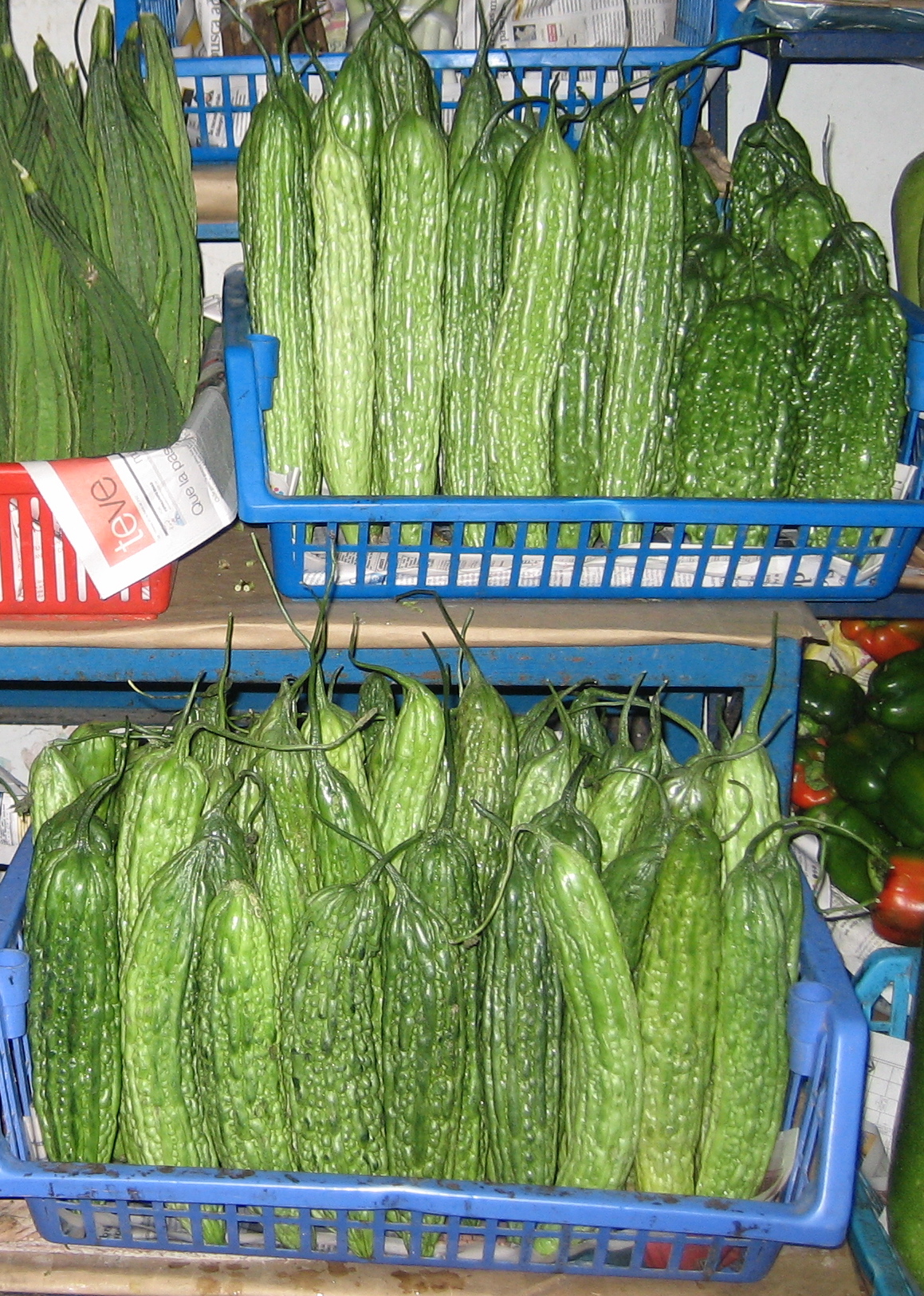
In the summer, my father used to grow one of his favorite vegetables, bitter melon (foo gwa).  You might see it in farmers’ markets now.  Their appearance prompts curious questions. They don’t look much like melons, their shape is more like a slender gourd or a plump cucumber. Their green skin is furrowed with deep wrinkles and their interior is filled with a white pithy mesh of seeds.

Like their name implies, they are bitter. Although Hakka and many Asians love their strong numbing bite, it may be an acquired taste for the uninitiated. I confess, even though I love bitter in many forms, I find this vegetable stronger than I like. Some cooks claim certain techniques mellow the bitterness. Some simmer the melon uncovered in broth, so the bitterness can dissipate. Marie Chang from Toronto adds tomato to the braising sauce to add some sweetness to balance the bitterness of the vegetable in her recipe (page 163).

Those who love this vegetable celebrate and savor its bitterness. Also many eat it for its health benefits. With all its claims, you might call it a super food.  It is often referred to as a plant insulin and can help lower blood sugar. Perhaps that’s why my father ate so much bitter melon, he had diabetes. It is also high in iron, potassium, calcium. It claims to combat cancer, viruses, colds, psoriasis, and high cholesterol.

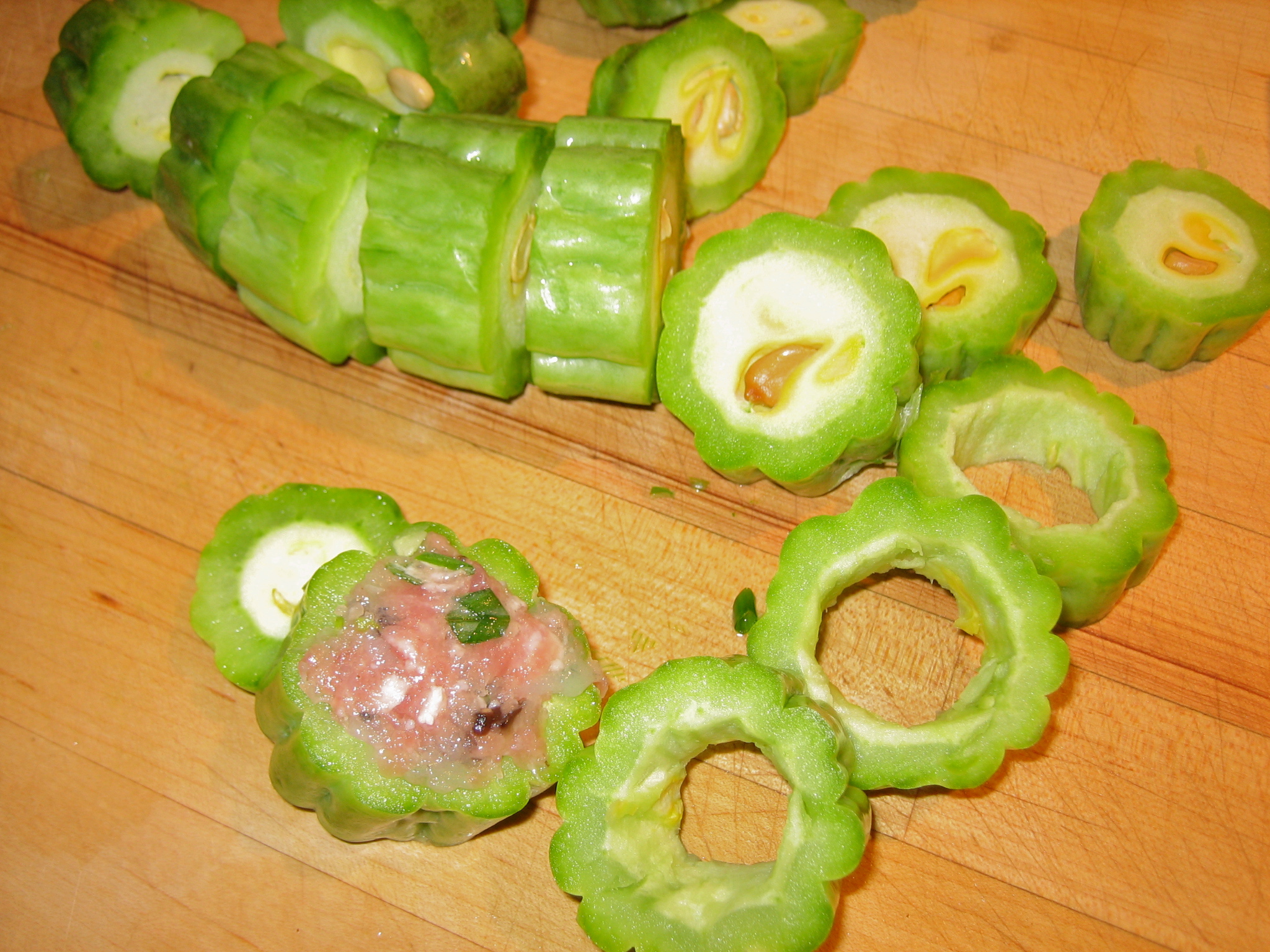
To stuff bitter melon: cut melon in rings, remove seeds and pith, and fill cavity.

My father, like many Hakka, liked to stuff the melon. He cut the melon crosswise in rings, removed the seeds, and filled the cavity with a pork filling. He poached it in broth to make soup. See my father’s recipe in the cookbook on page 24. In Hong Kong, I ate a new version stuffed with glutinous rice, Chinese sausage or bacon, and Tianjin vegetables (page 74).

The stuffed rings are most commonly poached in broth, pan browned and braised, or steamed. You can also slice the melon and stir-fry it. Or imbed thin slices in a frittata-like omelet (page 80).

The next time you see this funny looking vegetable, be adventurous and give it a try. You might like it.

Hakka Restaurant in Hong Kong

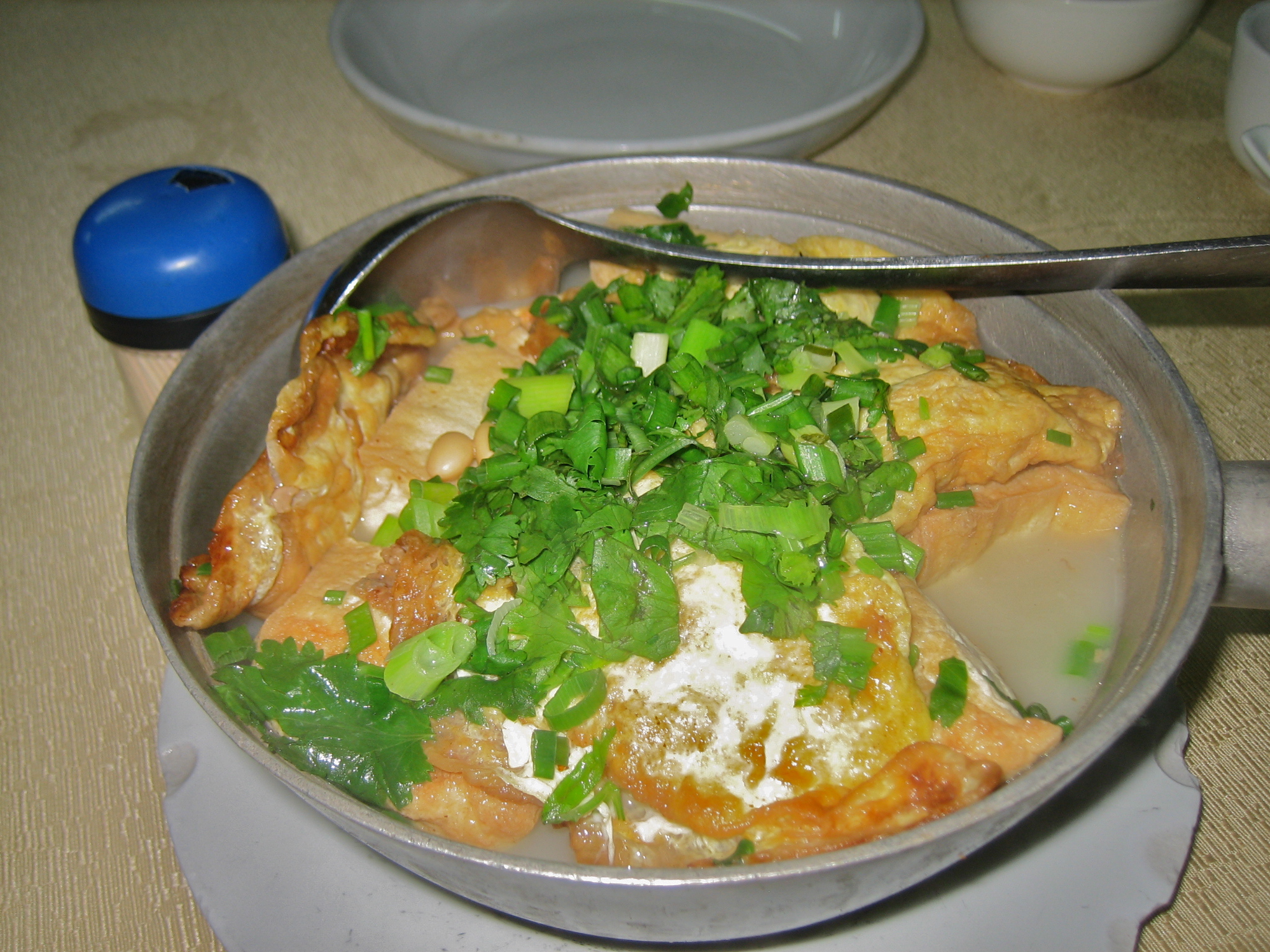
Stuffed tofu topped with fried egg with pork as served at Kong Hing in Hong Kong.

A couple of weeks ago on the way back from China, we stopped in Hong Kong for a couple of days.  Professor Sidney Cheung, whose interview appeared in The Hakka Cookbook, invited me to dinner at a Hakka restaurant, Kong Hing in Tai Wai. In this modest restaurant, we sampled several Hakka specialties such as salt-steamed chicken, stuffed bitter melon, and steamed pork belly with preserved mustard greens.

One of my favorite dishes that night was the stuffed tofu. The chef’s version came capped with fried eggs laced with bits of fried ground pork. To recreate, make the Fried Eggs and Chives (page 80) except replace the chives with bits of fried ground pork. Place the eggs over stuffed tofu (page 31, 33, 76, or 215) in a little broth in a clay pot or other small pan. Heat until bubbly, then shower with chopped green onions and cilantro. The eggs add an extra savory element to the tofu and stretch the number of servings.

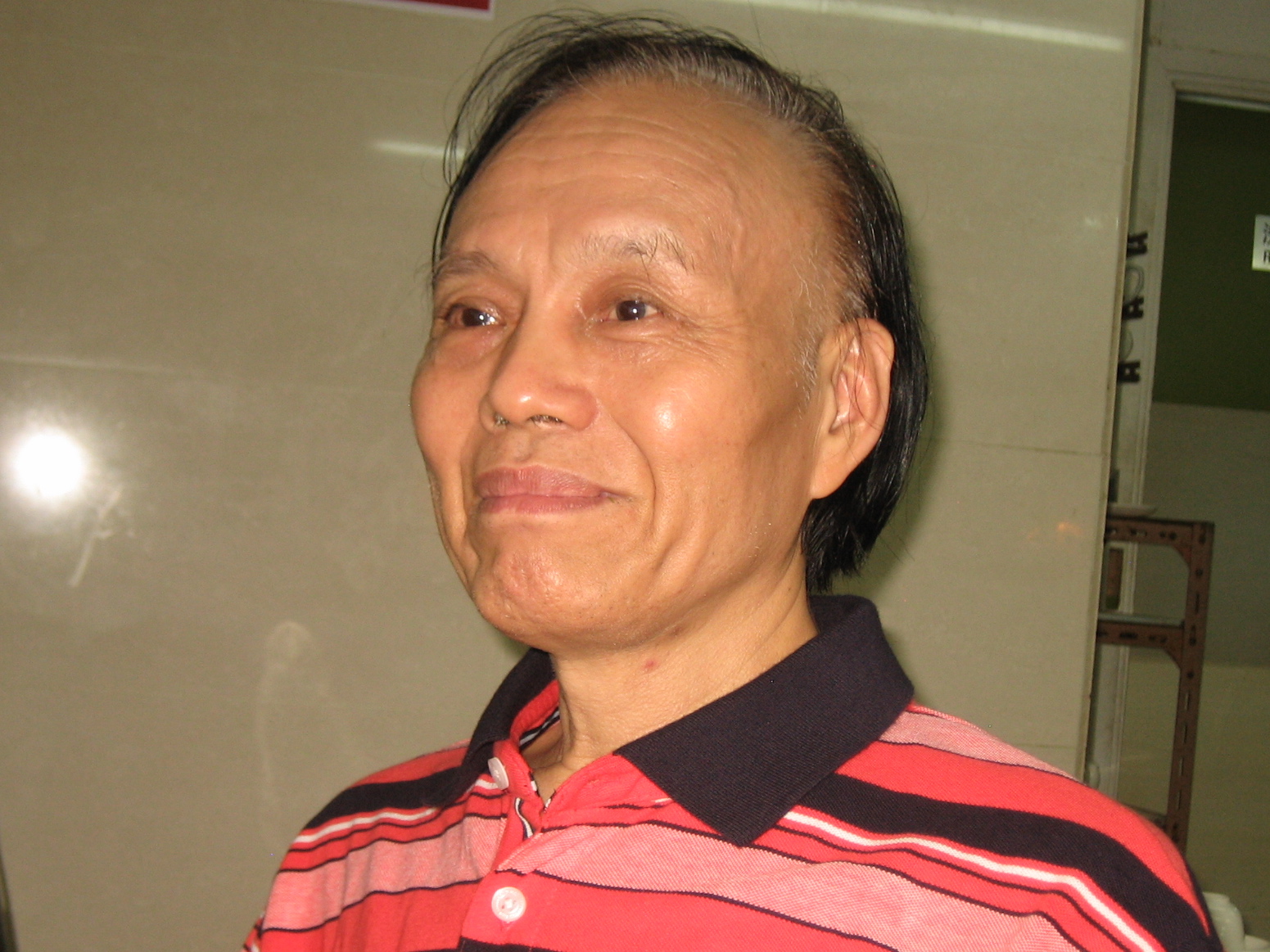
Chef Lau Chung Khong

After dinner, Chef Lau Chung Khong stopped by the table. We learned he originally came from the village of Shinling, also home of the Lau Family Association. His village was a neighbor of Moiyen, where my family was from, in Guangdong province. He came to Hong Kong as a teenager and worked in some Hakka restaurants. In 1988 he started his own restaurant. At his restaurant he serves homey Hakka dishes. At lunch, the rice plates are popular with local workers.

I asked my host, Professor Cheung, if there were many Hakka restaurants in Hong Kong. He said there aren’t many because of the high rents. Hakka food has modest ingredients and most are not able to charge high enough prices to cover the rent. Too bad, since the food is so delicious.

 Kong Hing Restaurant

G/F,  79-81 Tsuen Nam Rd,

Tai Wai, Tai Wai

Tel. 2691 6726 / 2601 2982

Fermented black beans

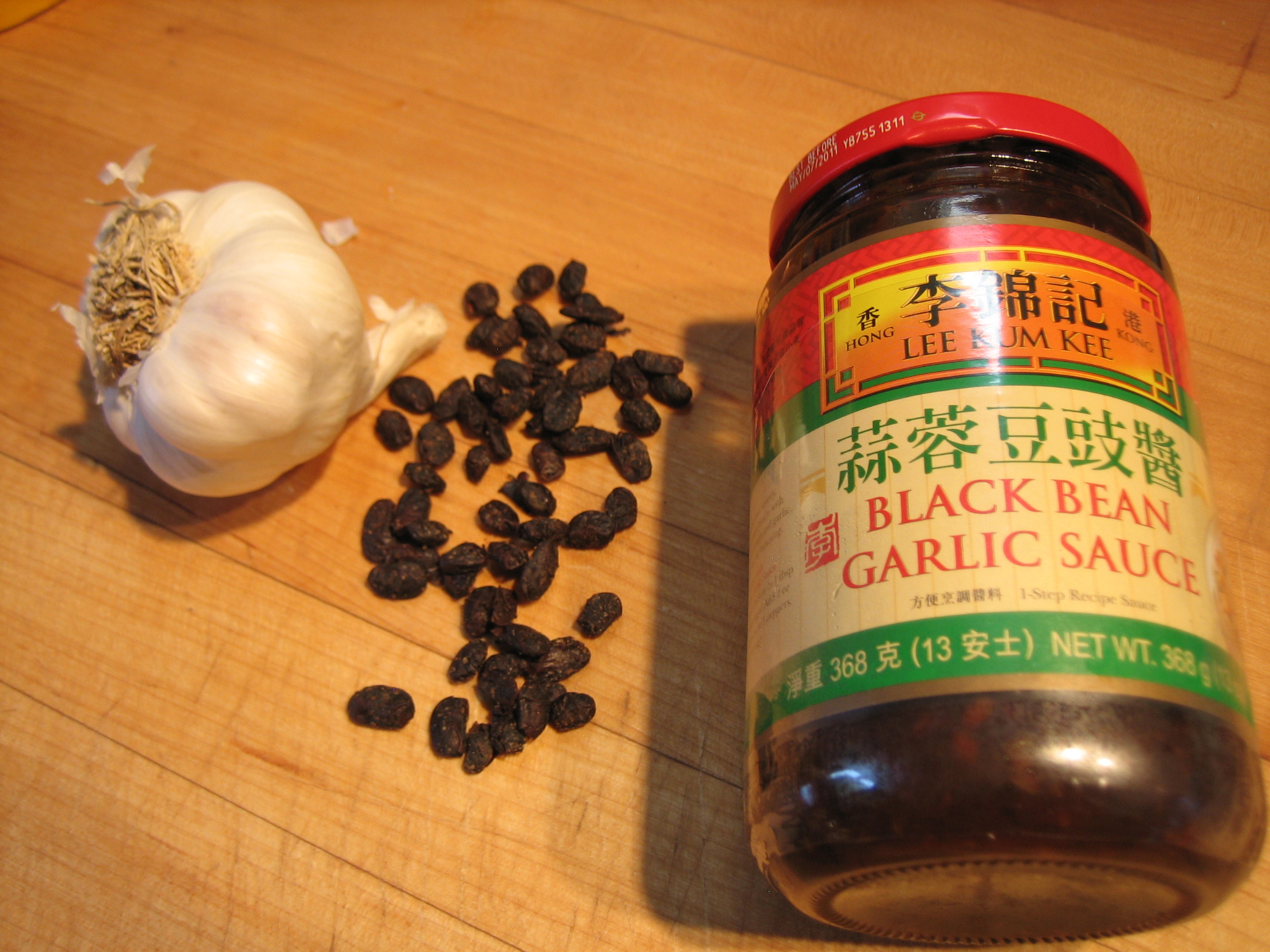
The key ingredients in black bean and garlic sauce are pungent, earthy fermented black beans and garlic.

The secret to adding robust, savory, salty nuances to food comes in the form of small black beans. These flavor capsules are soy beans fermented with salt and spices until pungent and aromatic. Called fermented black beans, salted black beans, preserved black beans or dou chi or dul see, they magically add a remarkable depth of flavor.

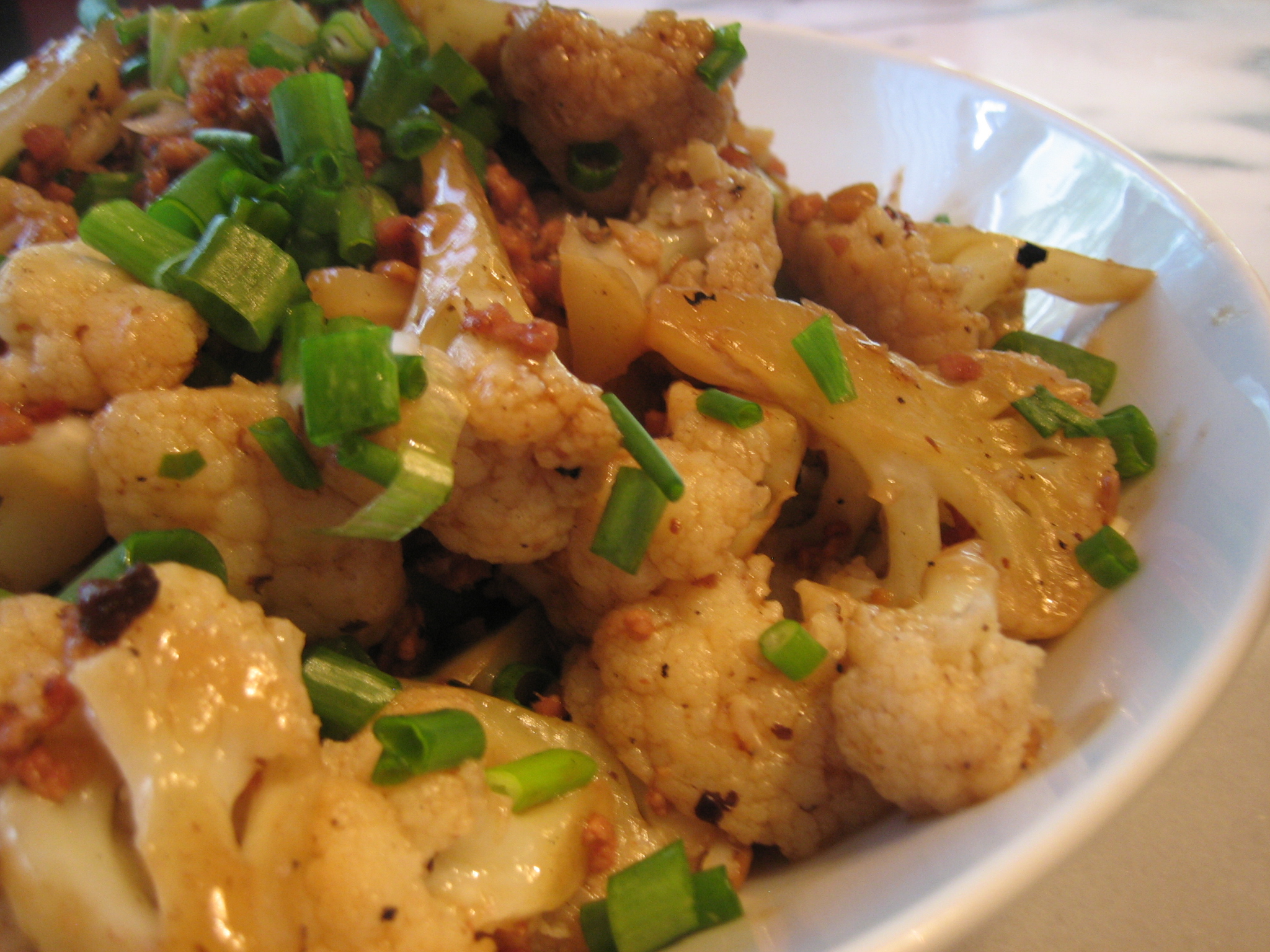
For instance, my mother often stir-fried cauliflower with fermented black beans. She would rinse the beans, then mash them with garlic with the end of the wood handle of her cleaver to make a coarse paste. She would mix the paste with minced fresh ginger and a little soy sauce. Then she would stir-fry the sauce with ground beef and cauliflower. The sauce contributed a earthy pungency to the somewhat bland cauliflower The recipe is on page 27 of The Hakka Cookbook. If you’re in a hurry, use a purchased black bean and garlic sauce found in many supermarkets. I find the Lee Kum Kee brand to be a good, widely available brand.

Chinese comfort food, Cauliflower and Beef in Black Bean Sauce

Look for fermented black beans  sold in plastic bags or round yellow cartons in Asian markets. The fermented black beans keep almost indefinitely stored airtight in the refrigerator. I also love a few black beans sprinkled over steamed fish or pork. Add a spoonful to stir-fried meat and vegetables. It is remarkably versatile and so delicious.

A Hakka feast

Minced Pork with Lettuce Wraps

I discovered the Hakka Restaurant when I was almost done with the research for my book. Luckily I was able to include talented Chef Jin Hua Li and a couple of his recipes in my book. When the San Francisco Professional Food Society (SFPFS) asked me to put together a menu from the Hakka Restaurant for their Traveling Table, a program that explores the bay area’s unique restaurants, I was happy to share his delicious food with them. Here’s the menu.

Minced Pork with Lettuce Wraps
Bamboo Pith Seafood Soup
Chinese Bacon with Preserved Greens
House Special Pan-Fried Tofu
Fried Pumpkin Strips coated with Salted Egg Yolk
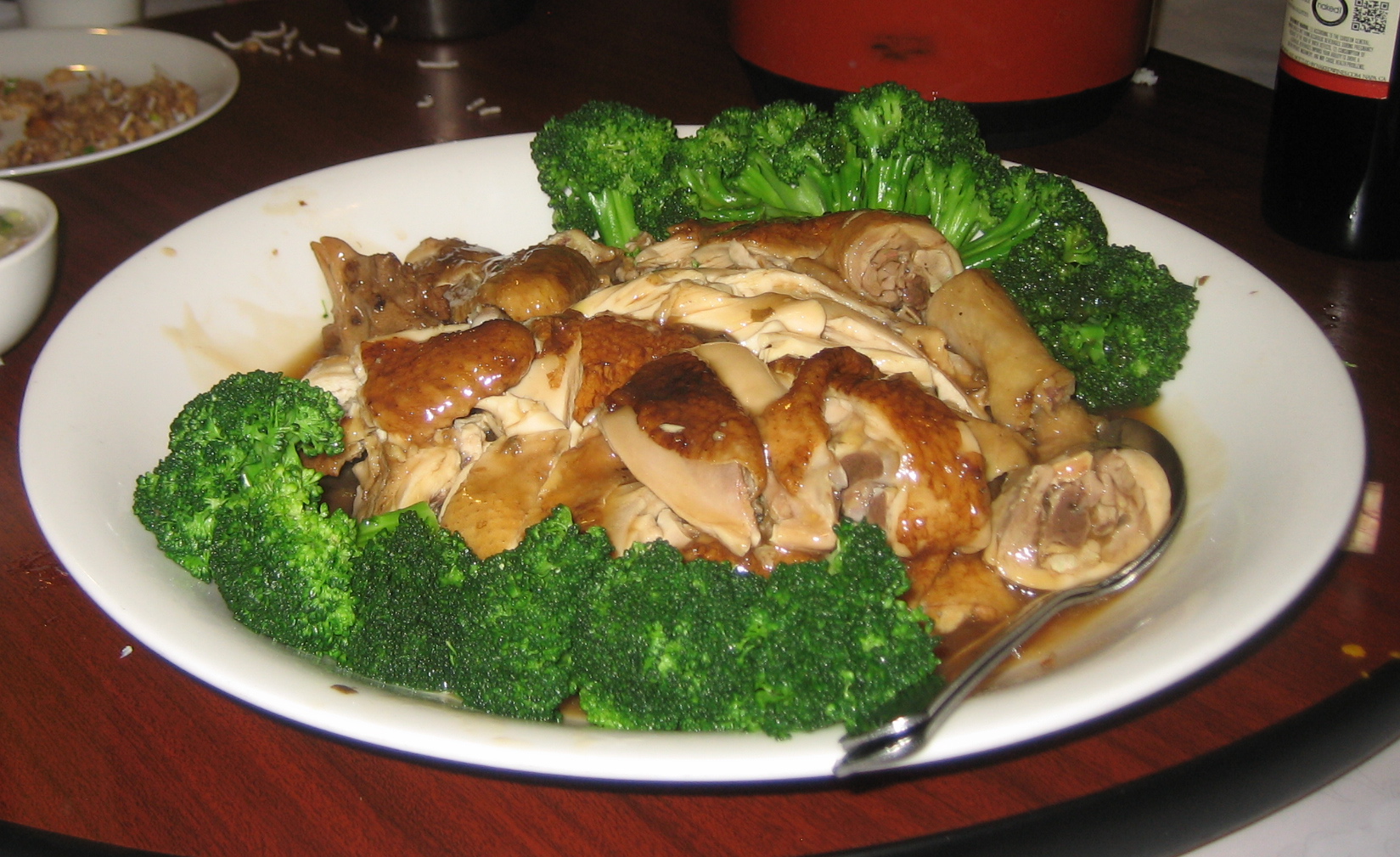
Chicken Stuffed with Preserved Greens (recipe pg. 233)
Stir-fried Chinese Broccoli with Rice Wine (recipe pg. 230)
Clams with Spicy Salt and Black Beans
Home-Style Steamed Sea Bass
House Special Eggplant
Steamed Rice

The lettuce wraps uses a well-seasoned pork as a simple filling for crunchy lettuce leaves. The mild soup, focuses on natural flavors and offers a light contrast to the more robust flavors in the meal.  The House Special Pan-Fried Tofu and the Chinese Bacon with Preserved Greens are Hakka classics. The Chicken Stuffed with Preserved Greens is one of Chef Li’s specialties, order a day in advance. The chicken is filled with a savory mix of preserved mustard greens, mushrooms, and pork, then braised.

Chicken stuffed with Preserved Mustard Greens at the Hakka Restaurant

The steamed fish is topped with a shower of typical Hakka ingredients pickled mustard greens and shreds of pork. Both the clams and eggplant dish reflect adaptations to local tastes as the Hakka migrated. The clams exude a spiciness reminiscent of Sichuan province.  The clams are deep-fried in their shells then stir-fried with fermented black beans, ground pork, chiles, garlic, and sometimes Sichuan peppercorns.  The tender eggplant tastes mildly sweet, sour, hot and aromatic with basil and cilantro, hinting of Thai seasonings. Hakka settled in both these areas, China’s Sichuan province and Thailand.

Everyone loved the meal. I think you will, too. The Hakka Restaurant is located at 4401-A Cabrillo Street (corner of 45th Avenue), San Francisco, CA 94121. Tel. 415. 876. 6898.

How to make wontons

Ready to make wontons? Start with a great filling. I have a delicious option in The Hakka Cookbook, page 148. Ground pork is flecked with dried orange peel (use fresh, if you don’t have dried). Tianjin preserved vegetables (use soy sauce as a substitute) contribute a savory saltiness.  And chunks of water chestnut pebble the filling with crunchy texture. Use the mixture as a filling for wonton or pat it into even layer and steam to make a juicy pork hash, Chinese comfort food.

For wonton, wrap the filling in a square pasta-like wonton skin, available in supermarkets and Asian grocery stores. There are many ways to fill wonton. My three-year grand daughter proved that to be true as she created her own technique for filling them. When boiled, it doesn’t make much difference. When I wrote the recipe to make wontons, I tried to find the technique that would be the most easily understood without photos. Unfortunately, the publisher had no budget for photos but you can see them here.

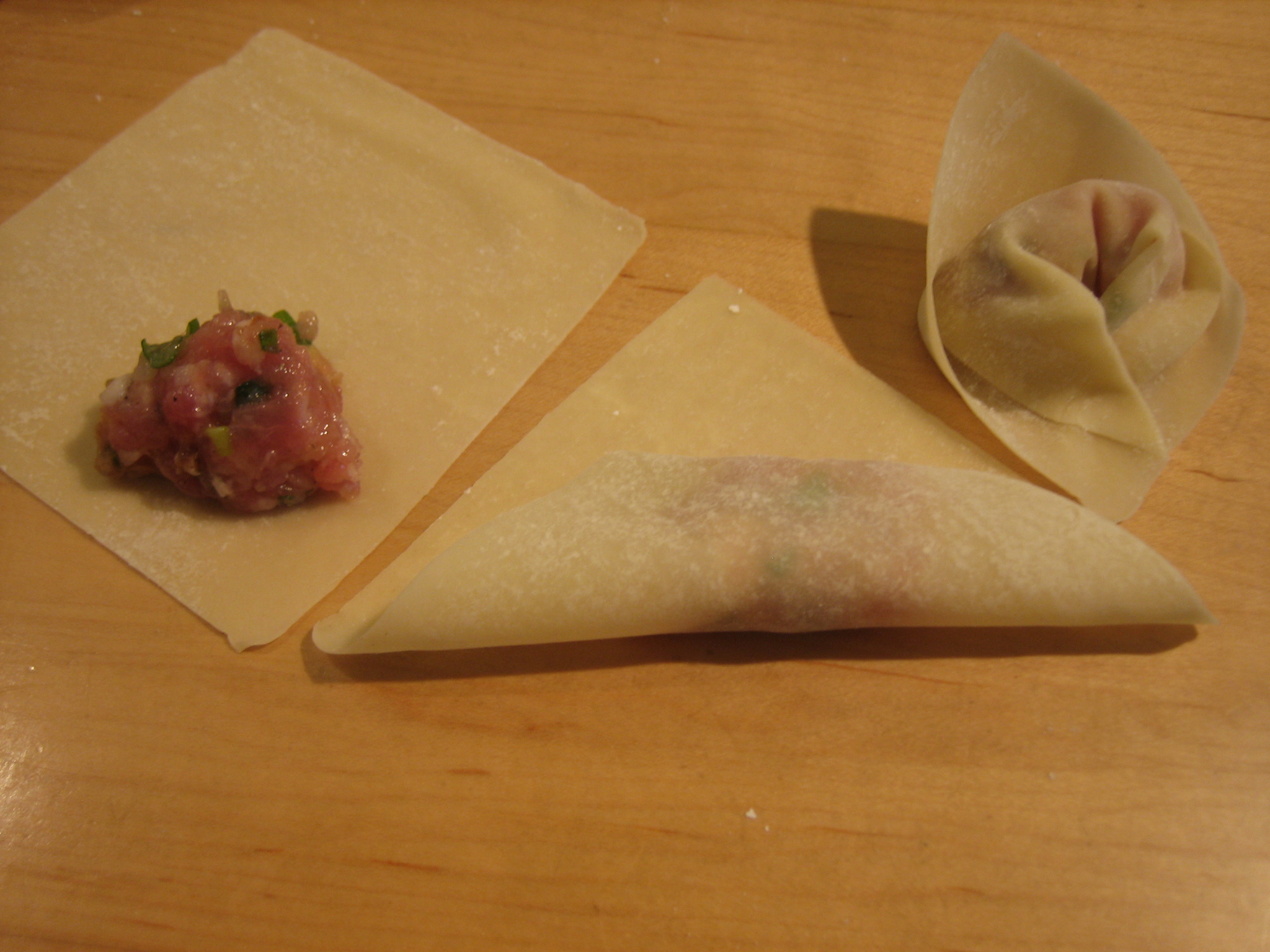
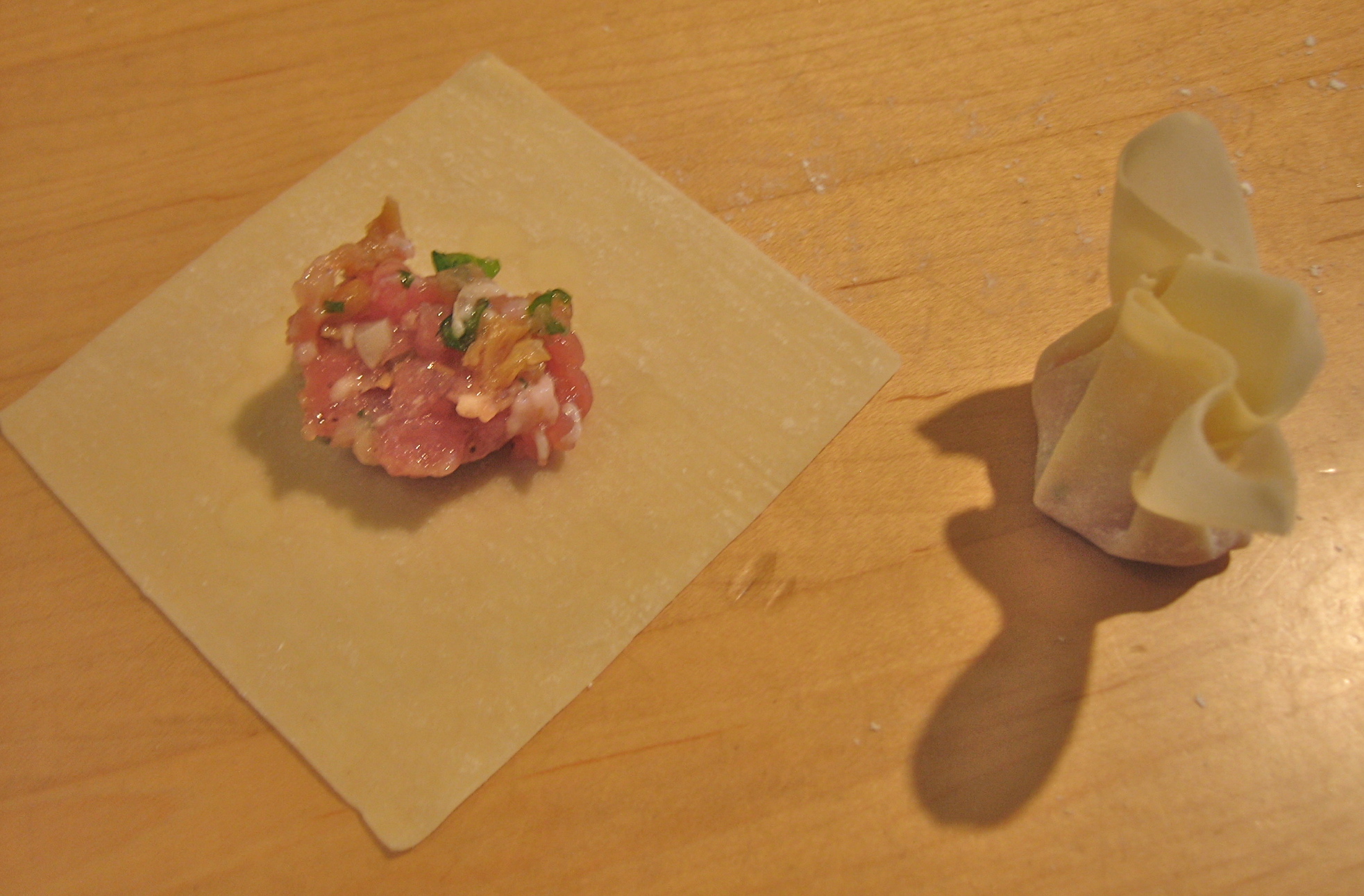
Place filling in center of wonton skin. Fold skin over filling to make a triangle. Pull ends down and seal tips with a little beaten egg.

For fried or boiled wontons, try this method: Place a wonton skin on a flat surface with a corner facing you. Cover the remaining skins with plastic wrap to keep moist (this is important, if they dry out they will crack when folded). Mound 1 level teaspoon of the pork filling in the center of the wonton skin. Fold the bottom half of the skin over the filling to make a triangle. Moisten one side corner of the base of the triangle with a little beaten egg. Now this is where it gets tricky without visuals. Pull the side corners down below the filling and overlap; press to seal. They should sort of resemble a tortellini with a triangular flap. I wanted to say “resemble a nurse’s cap” but nurses no longer wear white starched caps with wing-like flaps.

Place filling in center of wonton skin. Gather wonton skin up and around filling. Squeeze gently so filling sticks to wrapper.

If this seems too complicated, you can simply drop the filling in the center of the wrapper. Bring the wonton skin up around the filling, gather the skin around the filling and gently press the moist meat to the wonton skin so it sticks. I think this method is better for boiled wonton, but they can be fried. They’re just not as pretty as the first method when fried.

The filled wonton can be placed on flour-dusted baking sheets. Cover them so they don’t dry out. When done filling the wonton, cook, refrigerate for up to 8 hours, or freeze. When solid, pack the frozen wonton in containers, ready to boil whenever you need a quick meal or snack.


A Hakka cooking party

Linda, Nancy, and Ruby proudly display the dishes they cooked.

Gong Hee Fat Choy!  Happy New Year!  Chinese New Year is almost here. It arrives this Sunday, February 10. In the next couple of weeks family and friends will gather to share food and good wishes. In The Hakka Cookbook, you will find many recipes for specialties served for the New Year celebration.  Look under the Hakka Classics for recipes such as Salt-Baked Chicken or Steamed Pork Belly and Preserved Mustard Greens. But if you’re short of time or inexperienced in Chinese cooking, there are many other easy dishes you can cook for a festive meal. For me, the most important part of the celebration is getting together and reaffirming family unity and friendship.

Here are two suggestions for easy Chinese parties that anyone can manage. In the February 2013 issue of Sunset Magazine, look for Build your own bowl by Amy Machnak, pages 84 to 87. The easy noodle buffet party is based on recipes adapted from The Hakka Cookbook.

The second option is a cooking party. It started when a friend suggested we get together and cook from The Hakka Cookbook.  Last weekend, eleven of us gathered at Karen and John’s home in Paradise, California, where we cooked and ate a multicourse meal from the book. I designed the menu using seven easy recipes from the book.  I proposed instead of trying to cook all the dishes at one time, that we would cook and eat the dishes in several courses, as they were ready. Less stressful for the cooks. People could claim one recipe to make or we could take turns cooking. Karen volunteered to shop and prep most of the ingredients. I would bring ingredients she could not locate and a couple of woks for stir-frying.

You could easily duplicate this plan for your own party. This menu works well for six to eight people.  We increased the amounts for a few dishes for our larger group, or you could add more dishes. We cooked rice in a rice cooker, which kept the grain hot throughout our leisurely meal. There was plenty beer, wine, and tea to sip throughout the afternoon. The meal ended with tangerines, cookies, Chinese sesame candy, and candied coconut.

We gathered around noon. It soon became evident, only the women were interested in the cooking as the guys settled outside with beers. Didn’t matter, we gals had a great time reminiscing about old times (we’re known each other since kindergarten) as we cooked our way through the menu.

The Hakka Cooking Party

Melanee serves steeped chicken to wrap in lettuce leaves.

First course: Steeped Chicken (p. 22) with Fresh Green Onion-Ginger Sauce (p. 66).  Or use this adapted recipe at specialfork.com  Melanee claimed this dish. The chicken and sauce could be up to a day made ahead and brought to the party, ready to eat on demand. She served the moist shredded chicken with lettuce leaves, as a pick-up appetizer.

Second courses: Cumin Beef  (p. 183)  We had extra beef so we doubled the recipe. However, because it is important not to overload the wok when stir-frying thin meat slices, I cooked the beef in three batches (6 to 8 oz. each) so the slices would brown, rather than stew in its juices. After the initial stir-frying, I returned all the cooked beef to the pan with all the seasonings for a final blending of ingredients.

Stir-fried Snow Peas and Tofu (p. 48).  This mild flavored vegetarian stir-fry offers a contrast to the spicy cumin beef. It’s a study of contrasting textures with crisp peas, spongy tofu, and crunchy black fungus.

Third course: Cauliflower and Beef in Black Bean Sauce (p. 27) Phyllis took a turn at the wok and stir-fried this easy meat and vegetable dish. Ruby said she was surprised she liked it because she usually doesn’t like cauliflower. The black bean sauce really adds flavor to this rather bland vegetable.

Karen cuts cauliflower for stir-fry.

Fourth courses: Braised Pork Spareribs in Bean Sauce (p. 203). Since the ribs took longer to cook than most of the other dishes, I cooked them the night before and brought them ready to reheat. I increased the recipe by half since it was just as easy to make more. The savory sauce was delicious over rice.

Chinese Broccoli and Sweet Rice Wine (p. 230). This simple vegetable dish takes only minutes to cook. Ruby learned to cut the vegetables so all pieces are the same size.

Shrimp with Fried Garlic and Chiles (p. 78). Nancy fried bits of garlic and spicy chiles to top stir-fried shrimp.

We ate from noon to five, cooking, eating, and drinking. I directed the cooking and gave hands-on lessons on stir-frying, woks, and ingredients. We found when there’s a lot of cooks, it’s best to have all ingredients prepped ahead of time. Then cooking moves quickly without too much concentration. Everyone agreed they learned a lot, ate well, and would do it again.

To design your own cooking party, follow this easy plan. Have each person or couple be responsible for one dish. The dish could be completely made ahead ( if it works for that dish), or prepped for cooking on site. You can use this menu or design your own based on your own tastes. People take turns cooking and serving their dish. It is sort of like a cooperative home-style Chinese banquet.  Enjoy and have fun!  Gong hee fat choy!


Save your culinary history

Natalie Com Liu cooks her Hakka dishes in her kitchen in Lima, Peru as I record her recipes.

Zester Daily invited me to write a piece for Soapbox.  I struggled over the subject and wrote several different drafts. Eventually I settled on “recording your culinary history.” I was inspired by a blog post written by Pat Tanumihardja for The Asian Grandmothers Cookbook a few months ago.

A few days after I filed the post, I learned about the unexpected death of one of my Hakka contacts in Toronto. That reminded me of another contributor, a young chef from Beijing who had also passed away a few years ago. Life passes quickly. I’m so glad I was able to record part of their history while they were still here.

If you always wanted to know how your grandmother, father, or great-aunt cooks their special dish, ask them now. With Chinese New Years coming up soon, it’s the perfect opportunity to capture some of those special dishes. Spend some time with them. Watch them cook, take notes, shoot photos or a video, and taste their food. Record their stories and history. They will be flattered and you will be able to pass on their culinary legacy. Pretty soon, you will be writing your own family cookbook.

A lesson in soy sauce

Power to women! A few days ago, I gave a master class on Hakka Cuisine at the WCR (Women Chefs and Restauranteurs) National Conference in San Francisco.  This group of professional women in the restaurant business celebrated their 20th anniversary. It was an honor to meet such smart, strong, and supportive women. They reminded me of Hakka women, known for their hard-working characteristics and strength.

In my class, I provided a short tasting on different types of soy sauce, a primary ingredient in Hakka dishes. I thought I would share this information with you. Soy sauce is a seasoning liquid brewed from naturally fermented soy beans and wheat. It gives a deep flavor and rich color. The basic types are:

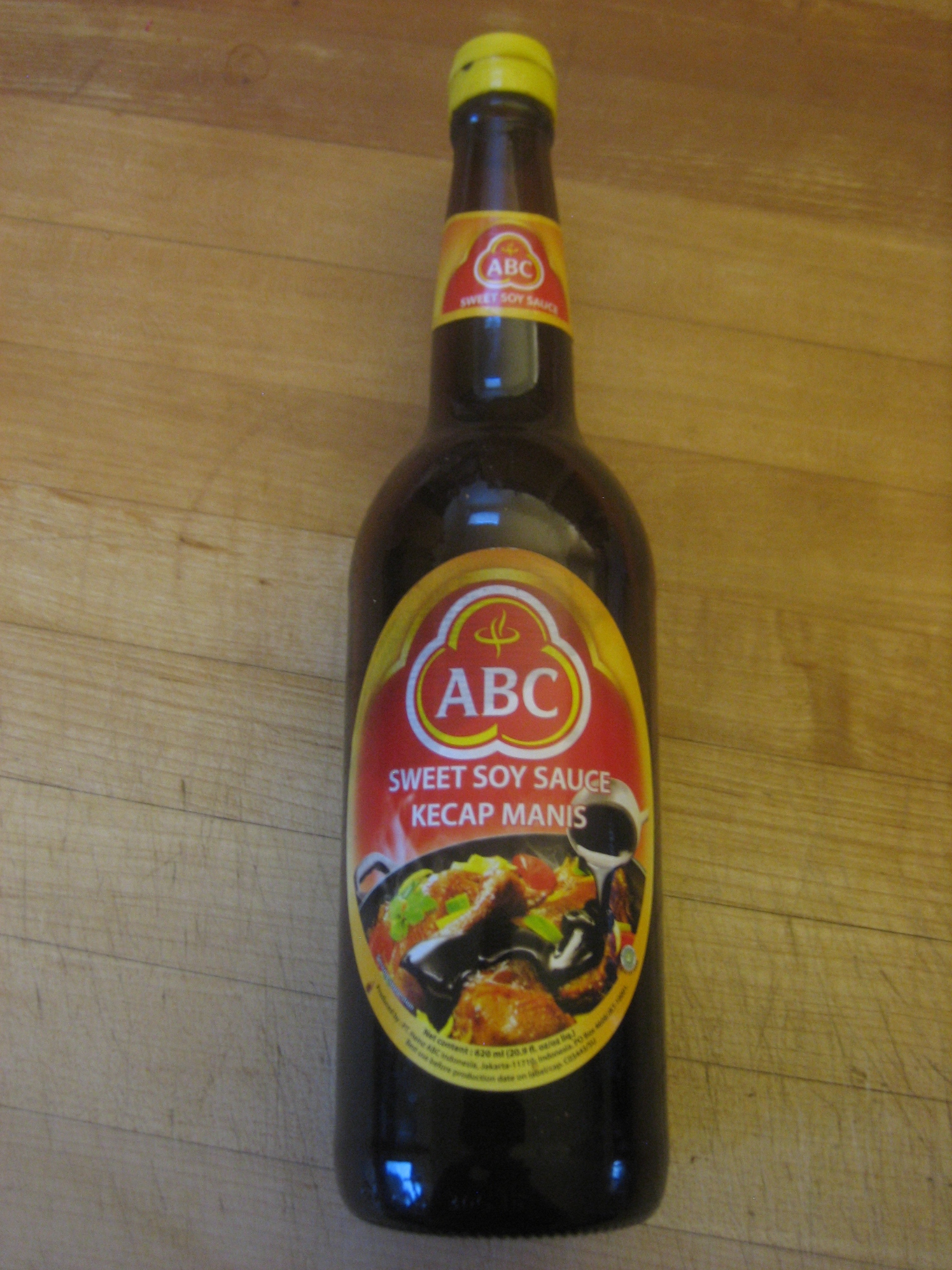
Soy sauce types: all-purpose soy sauce: Kikkoman or Pearl River Bridge Light Superior Soy Sauce; Koon Chun Black Soy Sauce; ABC Sweet Soy Sauce (kecap manis)

1. All-purpose soy sauce.  I simply call it soy sauce in the book. The Japanese soy sauce, such as Kikkoman has a higher percentage of wheat which mellows the sauce. Chinese soy sauce, such as Pearl River Bridge Light Superior Soy Sauce, contains a higher percentage of soy beans which produces a stronger flavor.  In Asia, this type may also be called light (not referring to sodium), white, or thin soy sauce.

2. Dark or black soy sauce. This soy sauce ages longer and is blended with a little molasses which lends a slight caramelized sweet finish. It is darker and has a stronger flavor which enhances the color of stews and braises. For a quick substitute, use 2 parts all-purpose soy sauce and 1 part molasses.

3. Sweet soy sauce. Often used in Southeast Asia. This dark, thick, syrupy sweet soy sauce is blended with palm syrup. The Indonesian version is called kecap manis. The Hakkas in India make a similar sauce and call it red sauce. They boil soy sauce, sugar, and fragrant seasonings such as ginger, lemon grass, tangerine peel, star anise, and cinnamon until the sauce is thick and glossy (recipe on page 269). Add the dark, intense, sweet sauce to noodles, stews, meats, and stir-fries, or use as a dipping sauce. For an quick alternative for cooking, mix equal parts dark (preferable) or all-purpose soy sauce and packed brown sugar.